Inland Marine Forms That Track Autonomous Mobile Robots Across Every Custody Hand-Off
Robot fleets change hands constantly, and standard marine forms leave gaps at each transfer.
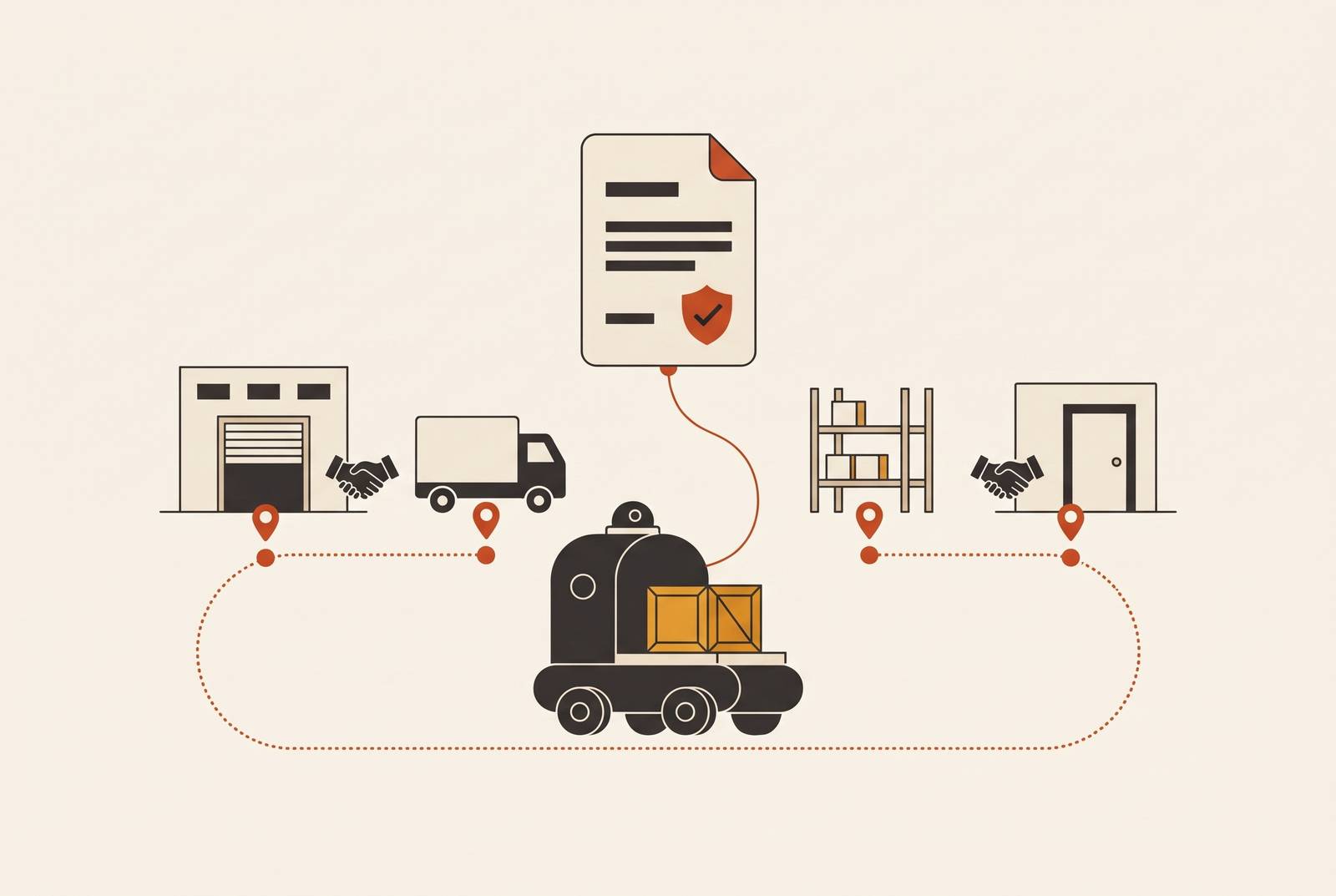
Inland marine coverage for deployed robot fleets insures mobile equipment away from the owner's premises, but an autonomous mobile robot needs wording that follows every custody hand-off as well as its movement between addresses. Coverage for robots traveling between job sites must link equipment protection to the liability policies that apply and the records that show who has custody.
Why inland marine exists and what it was built to do
Inland marine is property coverage for equipment that moves, travels in transit, or remains temporarily away from a company's premises. Its name comes from cargo insurance. Its modern scope includes gear at jobsites, on pilots and demonstrations, and at customer facilities where standard commercial property coverage stops. The class also includes fixed instrumentalities of transportation and communication, including bridges, tunnels, and cell towers, so its reach extends beyond freight.
For a robotics startup, equipment coverage written as inland marine is the second line needed after general liability, with each unit scheduled at its replacement cost. A fleet's most valuable equipment may spend its working life outside the owner's walls, so customer-site pilots and moves between facilities are main exposures, even if they are treated as exceptions. The form was built to follow property, leaving responsibility for it at each moment unresolved.
What an AMR actually does between deployments, and why that chain of movement is unlike passive cargo
An autonomous mobile robot, or AMR, passes through several custody boundaries while it is deployed for a customer. Its route can begin on a factory floor, continue onto an outbound truck and a customer's receiving dock, and then move into autonomous warehouse operation. It then charges before it moves to another customer or makes the return journey. No single operator controls the whole sequence. Each hand-off changes who holds or operates the machine.
Unlike a pallet, the AMR also acts within that sequence. It navigates, avoids obstacles, and executes tasks without a human at the controls. Autonomous delivery systems add a parallel record of the goods they handle. US Patent 11142401 describes tracking markers on items, read by sensors or scanners on the robotic unit, that record container access, item removal, the person accessing them, and delivery to the specified location. The robot is both carrier and logger.
US20210129843A1 describes handing an autonomous follower from one leader to another, while US12079008 addresses a dynamic autonomous vehicle train. These arrangements change the control relationship without requiring the conventional unloading and receipt of freight. Control of the robot can change during the journey itself. The resulting movement map contains more nodes than a standard bill of lading contemplates, with autonomous actions occurring between them.
Where standard inland marine forms break along the custody chain
The customer-site gap begins with care, custody, and control. Once an AMR operates on a customer's floor, it may be in that customer's care, custody, and control, even though another company owns it. A standard general liability policy excludes damage to property within that relationship, while the maker's or operator's inland marine form may not extend into it without specific endorsement. The wording must address the relationship under which the customer holds the machine.
Bailee's Customer Coverage, a type of inland marine, was designed to address customer property left in a shop or in transit. The differences between standard equipment and bailee's forms make coverage for a particular custody arrangement depend on the specific form within the broad category “inland marine”. A form can list the street address accurately while describing a relationship that differs from the one at the loss location.
The inter-operator gap occurs when a rental or shared-fleet robot moves from one customer to another. There may be a point when neither the outgoing customer nor the incoming customer formally holds the unit. Conventional wording organized around a single named insured does not resolve that interval merely because both destinations are known.
The return-leg gap concerns robots heading back to a depot or moving between sites for rebalancing. One reading may treat the machine as in transit, while another may treat it as not scheduled at an insured location. Without wording that covers the journey, it can fall into a gap between inland marine and auto liability provisions. The form must distinguish the robot's property exposure from the liability exposures associated with its movement.
The autonomous-operation gap appears when navigation causes the robot to damage itself or third-party property outside a conventional transit or fixed-location description. Standard property forms separate property events from software events, but an autonomous decision can connect them in one incident. That exposes a boundary between policies as well as within the equipment form. Builders risk, inland marine, general liability, and property coverage do not overlap perfectly, so each hand-off can expose a different seam. These are not hypothetical drafting problems, but consequences of applying decades-old form logic to a machine that did not exist when that logic was established.
How the AI-decision layer turns each custody gap into a liability tangle
An AMR does more than change hands. Its sensors, software, and AI models decide how to act as conditions change, so a loss during a hand-off can involve sensor reliability, software version history, and edge-case validation records. One incident can lead to claims against the hardware maker, software developer, and operating company. Identifying the custodian therefore does not, by itself, identify the responsible party.
The inland marine form covers the hardware, but it has no mechanism for allocating the software-caused portion of a loss among those parties. At a customer site, possession may sit with the customer while the disputed decision originates in the robot's software. During a transfer, the same incident may require both a property determination and a liability allocation. AI remains insurable despite these specific limits in the form's wording.
A custody-aware property form can state when protection follows the machine, but it cannot substitute for every other line in the program. The liability wording must also address the parties whose work contributed to the event. Otherwise, resolving the physical location leaves the causal dispute untouched. A program built around autonomous equipment has to connect these questions without treating property ownership as a complete account of responsibility.
What decisional logs and standardized data formats now mean for inland marine claims
The robot's decisional logs are becoming the functional equivalent of its bill of lading. Sensor, navigation, and decision records establish where it was, what it did, and who held it when the event occurred. Claims investigation increasingly turns on that evidence. Policies requiring owners to grant insurers access to “Action History” data make the connection explicit, treating the machine's record as a claim document.
PICC's coverage of Sharebot's robots sets a precedent for units that move between customers and have no fixed operating address. The coverage follows the machine's movement record. That approach connects custody evidence to the coverage trigger. For inland marine purposes, the form must address both continuity across holders and access to the records needed to establish that continuity after a loss.
Data format is a separate but related question. MCAP provides a standardized container for heterogeneous robotics data, but its published description does not establish insurance underwriting or claims use. A standardized format is not itself a coverage provision. The relevant insurance questions remain what the robot records, how long those records remain available, and who can obtain them. Those questions belong in the submission before the policy is written, so they are raised before a claim is in dispute.
How market leaders are beginning to write forms that actually follow the robot
Tokio Marine & Nichido announced “AI Robot Insurance” on October 26, 2026, for November 2026, covering wheeled, quadrupedal, and humanoid robots. The product covers equipment damage, third-party liability, and business continuity costs, including the cost of replacement personnel and substitute robot rental during downtime. The price depends on how and where each robot is used and is roughly higher than conventional industrial equipment premiums. Cyber incidents are explicitly excluded from the product. Its relevance is the combination of equipment and operational exposures within one form.
Allianz Partners announced its Waymo arrangement in September 2026, including motor fleet insurance, product liability coverage, and new insurance models for autonomous mobility platforms. The initial focus is Germany and Munich as robotaxi units prepare to launch there, with London also in preparation. It is not a simultaneous London launch. The arrangement shows how insurance lines can work together for a fleet in autonomous mobility when the parties that run it include more than one equipment owner.
Axis Insurance built a program for companies that make and deploy autonomous robots to cover production losses from a software update or sensor failure, even when there is no physical damage. It also addresses cases where a third-party sensor defect causes a failure but the claim reaches the integrating company. The distinction is substantive in the coverage wording.
Bot Auto secured a comprehensive program underwritten by an A-rated carrier, combining auto liability, property, general liability, cargo, and inland marine for autonomous freight trucks. A separate cyber policy complements that package.
Munich Re's aiSure provides performance warranties for AI vendors and providers and corporations deploying AI systems. It covers the financial-loss layer that standard product liability and inland marine forms usually leave out. It addresses a different part of the exposure. These products show several ways to cover the risks of autonomous deployment, but their different uses give no basis for saying that every product has robot movement as its coverage trigger.
How do you insure a mobile robot fleet across multiple locations with a custody-aware submission?
The submission needs the deployment chain alongside the equipment schedule. Standard commercial applications have no fields for custody transitions, supervision models, operating envelopes, or data-access provisions. Without that information, an underwriter lacks a basis for distinguishing a governed autonomous fleet from an uncontrolled one. The robot can then be priced like rented construction equipment, with restrictive exclusions or no quote. Specialist submission preparation supplies the missing account of how the machine works in the field.
The submission must map every custody transition in a typical deployment and name the parties and the contract that governs each hand-off. It must also describe supervision at each stage and state whether the robot is fully autonomous, remotely supervised, or supported by a technician. Autonomy is not constant across a deployment. The operating envelope should therefore identify geofencing boundaries, speed limits, restricted zones, and the conditions under which the robot stops and waits for human intervention.
The evidence package must describe the logging architecture, including recorded data, format, retention, and claims access. It should link those records to a safety-case file that holds incident logs, near-miss records, software version history, and third-party component audits. Each record has a distinct evidentiary purpose. Together, they give the underwriter a basis for addressing losses involving the hardware maker, software developer, and operator without assuming that the party holding the robot caused the failure.
Contractual insurance requirements complete the custody map by showing what site owners and logistics partners require at each stage. They also show which certificates have been promised and where higher limits may be needed. The submission should go to specialist underwriters who explicitly cover autonomy. Specialist broker preparation is the mechanism for translating custody transitions, data-access provisions, and bailee endorsements into policy wording when the standard application has no place for them. The decisive submission is the one that makes every hand-off visible before the loss occurs.