The Tri-Layer Coverage Checklist Hardware Founders Should Run Against Every Enterprise MSA Before Signing
Three insurance layers hardware founders must verify before signing enterprise contracts.

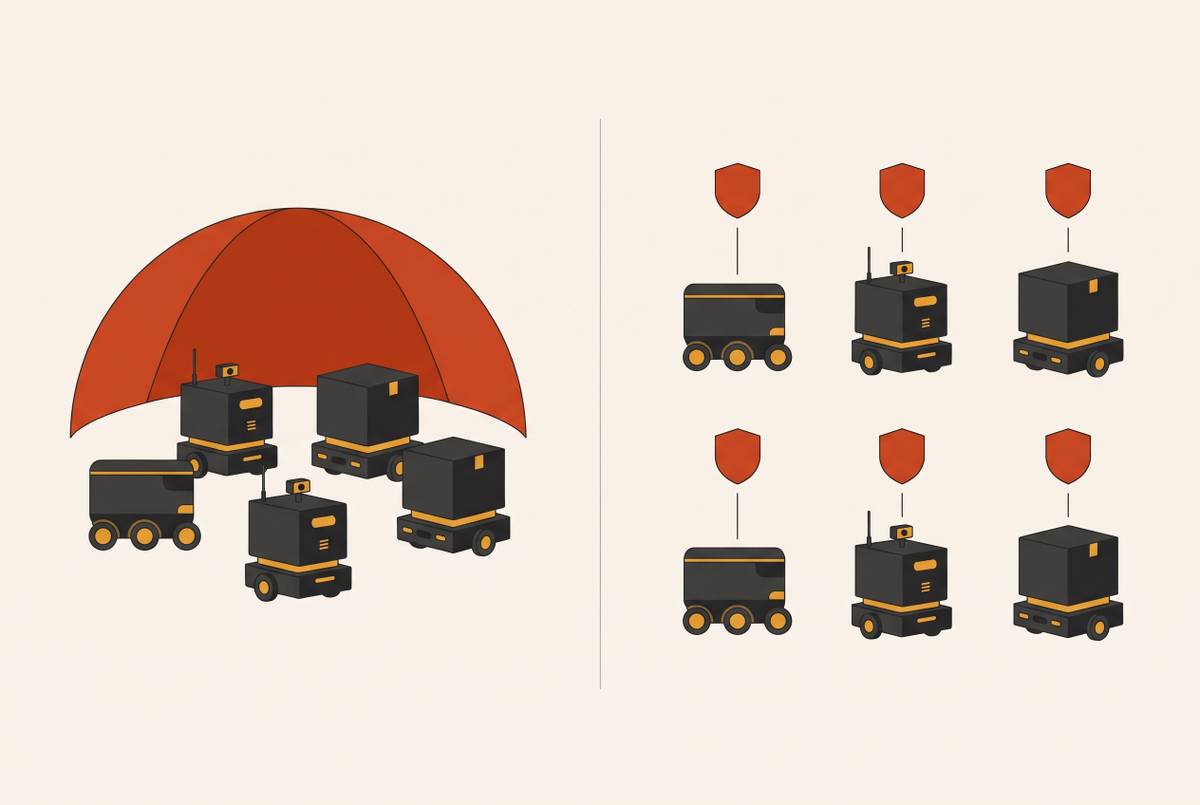
MSA insurance clause review for hardware and robotics startups requires three separate checks before signing, namely limits calibrated to the deployment, coverage lines that affirmatively cover autonomous operations, and endorsements that match the contract’s additional insured, subrogation, and cancellation terms. A policy can meet an enterprise’s required dollar limit yet exclude the work being purchased.
Why enterprise MSAs have become a coverage trap for hardware founders
Enterprise MSAs are imposing stricter insurance obligations as coverage for autonomous hardware becomes narrower. The timing creates pressure from both directions. A customer may demand broader protection just as the founder’s insurer excludes the operations that create the customer’s exposure. Accepting the contract without comparing its terms with the actual policy can leave the company bound to obligations its insurance cannot fund.
Physical AI systems combine sensors, software, and models to decide how to act as conditions change. Fault rarely belongs to one party alone. After an incident, the hardware maker, software developer, and operator may dispute who is at fault, and the losses may fall under more than one policy. The same line may not cover physical damage, production that has stopped, and failures in professional services.
How ISO's 2026 AI exclusion endorsements changed the CGL baseline every MSA assumes
ISO issued three generative AI exclusion endorsements for commercial general liability in January 2026, namely CG 40 47, CG 40 48, and CG 35 08. CG 35 08 specifically excludes bodily injury and property damage arising out of generative artificial intelligence. That exclusion also reaches the products-and-completed-operations exposure from equipment shipped to customer sites. The endorsement changes what sits behind the limit. A CGL policy with that endorsement may not pay for an AI-directed physical loss that it excludes.
An MSA requiring standard per-occurrence and aggregate CGL limits may not specify which version of the form is acceptable. A founder could satisfy the stated limit with a post-January 2026 policy bearing CG 35 08 while leaving the contracted operation uninsured. Conversely, the absence of an explicit exclusion does not establish affirmative coverage. Leung et al.’s The Insurability Frontier of AI Risk maps 55 AI threat classes against 26 insurance products, endorsements, and exclusion regimes and identifies silent-AI exposure where AI’s role as an instrumentality is distinct from the legal cause of loss.
Layer one of the checklist: reading the limits clause against what your operations actually expose
Enterprise procurement schedules set the minimum limits for cyber liability, Tech E&O, CGL, and umbrella follow-form coverage. For deployments that are mission-critical or regulated, the Tech E&O limits required can be much higher. But those template numbers are based on what is expected of a conventional software vendor and leave out part of the loss profile of autonomous hardware. A robot that stops a production line creates an exposure that cannot be measured by the replacement cost of damaged equipment alone.
The first-layer question is whether each required line’s per-occurrence limit can support the realistic worst-case loss from the specific deployment. Production losses need their own coverage analysis because a policy responding to physical damage may not pay them. Xu et al.’s When Agent Automation Becomes Profitable describes agent liability as a joint property of the customer, task, assets, and trace. Context determines the potential severity of a loss. The same model can be harmless in a test environment and catastrophic in a regulated financial workflow, so a generic limit cannot establish adequacy by itself.
Accumulation creates a separate problem for limits. A flaw in a widely used model can affect many businesses at once and use up the available coverage through a systemic event that goes beyond a single equipment failure. The review must check both the per-occurrence limits and how much of the aggregate is available for related losses. A follow-form umbrella above CGL amended with CG 35 08 provides no additional protection for losses excluded by the underlying form.
Layer two of the checklist: verifying that each required coverage line actually responds to autonomous operations
CGL is the first line to test because its presence can obscure an exclusion affecting the core deployment. An AI-driven sensor that misreads conditions after delivery may cause bodily injury or property damage within the products-and-completed-operations category, yet CG 35 08 can exclude the claim. Gallagher Re found that products coverage may pay for injury and property damage caused by an autonomous system, especially where the law that applies treats AI software as a product. Financial losses from the same failure receive no coverage under a products form, making jurisdiction and loss type central to the check.
Tech E&O wording must affirmatively cover the relevant failure for the policy to cover exposure removed from CGL. An agent can produce a damaging output or fail to perform without any security breach, leaving cyber and Tech E&O to respond under different triggers. NYU Tandon’s analysis distinguishes cyber’s security and privacy focus from Tech E&O’s professional-failure and platform-performance focus, while noting ambiguity for hallucination, bias, or drift when wording is not affirmative. The Leung paper calls this uncertainty “silent AI exposure,” where neither party knows in advance whether a failure is covered, excluded, or outside conventional structures.
Inland marine and equipment coverage turn on what property the policy actually schedules. A generic requirement leaves the details unresolved. Autonomous robots in transit or at customer sites may be excluded or undervalued if the policy does not schedule them specifically. Carriers increasingly ask for equipment schedules and the locations where high-value equipment is in transit or stored, linked to the peril exposure zones they fall within. The comparison is therefore between the actual fleet and logistics chain and the carrier’s form conditions.
A pure AI-behavior failure can cause damage without an attacker penetrating the network. Beazley and QBE drafted AI sublimits below overall policy limits, although Beazley subsequently stated that the wording had not been applied to active policies and confirmed AI-affirmative cover, while QBE maintained that it was not retreating from AI coverage. Those distinctions make the executed wording decisive. The Leung paper also identifies foundation model concentration as a novel insurability problem because upstream failure can correlate losses across policyholders, a scenario no standard cyber form addresses.
D&O is easy to overlook in an operational insurance review, even though virtually every institutional VC requires it at Series A. An MSA requirement does not establish that the policy covers AI-related board claims. W.R. Berkley introduced an absolute AI exclusion affecting D&O, E&O, and fiduciary liability for claims arising from actual or alleged AI use, deployment, or development, including AI practices and disclosures. Governance records do not erase that exclusion. The founder must check the D&O wording specifically and establish whether required model inventories, oversight frameworks, and approval processes are in place.
Layer three of the checklist: how to review additional insured and indemnification language in a hardware MSA
Indemnification is the contractual obligation beneath the administrative terms. Since 2024, enterprise MSAs for AI-adjacent vendors have made them responsible for output errors, training data warranties that cover client data, and losses tied to AI-generated outputs. Some output-error provisions use caps set at multiples of annual fees. If the promise exceeds the policy’s terms, the difference remains an uninsured exposure regardless of whether the limits and coverage lines otherwise look adequate.
Additional insured status requires an endorsement that meets the contract’s terms. The MSA does not create it automatically. A customer requiring a scheduled endorsement naming a specific entity may not accept a blanket additional insured form. For hardware at customer sites, the review also extends to property and inland marine arrangements because equipment damage can implicate the founder’s liability policy and the customer’s own property policy. Who is named where affects the recovery rights between those policies.
A waiver of subrogation changes who the insurer can pursue after paying a claim. Its scope requires more than a box check. A waiver protecting the enterprise customer may be broad enough to foreclose recovery against an AI model vendor or component supplier whose failure caused the incident. That restriction can affect recovery and the insurer’s willingness to pay. The relevant comparison is between the parties protected by the waiver and the parties that could contribute to an autonomous-system loss.
Cancellation notice must also match what the policy endorsement requires, so the certificate alone is not enough. Standard CGL terms may allow shorter notice for non-payment than for other cancellation. If an MSA requires the same advance-notice period for every cancellation, it can demand more notice than the policy requires. A certificate of insurance carries notice promises that are nonbinding on the insurer, and some enterprise contracts now require notice directly from the insurer.
What underwriters are actually looking for when a hardware company presents an MSA
Underwriters assess the contract and the operation together when deciding availability, terms, and price. For policies with higher limits, they look at indemnification, limitation of liability, and carve-outs that remove caps for data security events. A clean submission also identifies where AI is used, how tools are approved, and who oversees them, supported by model inventories and risk registers. Some carriers seek model risk assessments, adversarial testing results, and safeguards aligned with the NIST AI Risk Management Framework.
The Xu framework points toward tool-use traces, defined role permissions, and bounded operational scope as inputs to underwriting. Even the same robot can present different risks in two warehouses because layouts, worker interactions, software versions, and operating limits differ. Those variables reduce the usefulness of generic applications. Documenting them allows pricing to reflect the actual exposure.
The way specialists set prices shows this shift, though it does not show whether a given founder can get the coverage. China Pacific Insurance sells humanoid robot coverage by the day, week, or month to match how long the rental lasts. Lemonade offers a 50% per-mile discount when Tesla’s Full Self-Driving system is engaged, with a smaller discount for older HW3 vehicles using FSD Lite. The operational context defines the risk unit. The Leung paper likewise finds that specialist AI coverage differs by the main risk it covers, which supports choosing a carrier that wants to cover the specific perils of the deployment.
Running the three-layer check before signing: a practical sequence for founders
The practical sequence begins with the full contract stack before any insurance promise is accepted. Read the MSA, statement of work, data-processing addendum, and public product claims together. Check commitments on accuracy, uptime, security, indemnity, IP, and permitted output use. Flag unlimited AI-output indemnities, broad client-data training warranties, AI liability caps at multiples of annual fees rather than standard 12-month fee caps, unilateral termination for model changes, and 24-hour incident notification. These promises define the exposure the insurance review must test.
Next, compare the deployment’s realistic losses with each required limit and then test the coverage beneath it. For CGL, check for CG 35 08 or equivalent exclusions and identify specialist affirmative bodily injury and property damage coverage where needed. For Tech E&O and cyber, verify AI-failure triggers and any sublimits against the accepted indemnity. Equipment schedules must match the equipment’s make and model, where it is deployed, and how it is moved. Complete the coverage review by checking D&O exclusions and governance requirements, products liability jurisdiction, and the underlying forms followed by umbrella or excess policies.
Then reconcile the administrative obligations with the endorsements themselves. Obtain the scheduled additional insured endorsement naming the exact contracting entity on the required form, and address inland marine where equipment is deployed at the customer site. Check that the subrogation waiver preserves recovery against relevant third-party model and component suppliers. Match the cancellation terms, including those for non-payment, to what the MSA requires. Confirm that the insurer owes the required notice.
Finally, build the submission around this deployment with a specialist broker who reads the contract and documents the autonomous operations. Provide the model inventory, oversight framework, testing evidence, equipment details, and actual indemnification language. The quality of the submission affects both the coverage terms and the price. Broker commissions are already included in the premium, so specialist placement adds no separate cost beyond it. Resolve any remaining mismatch in the MSA or policy before signing, while both are still open to negotiation.