Blanket Versus Scheduled Inland Marine Forms for Autonomous Robot Fleets
A hybrid policy works best, but only if caps match robot values.
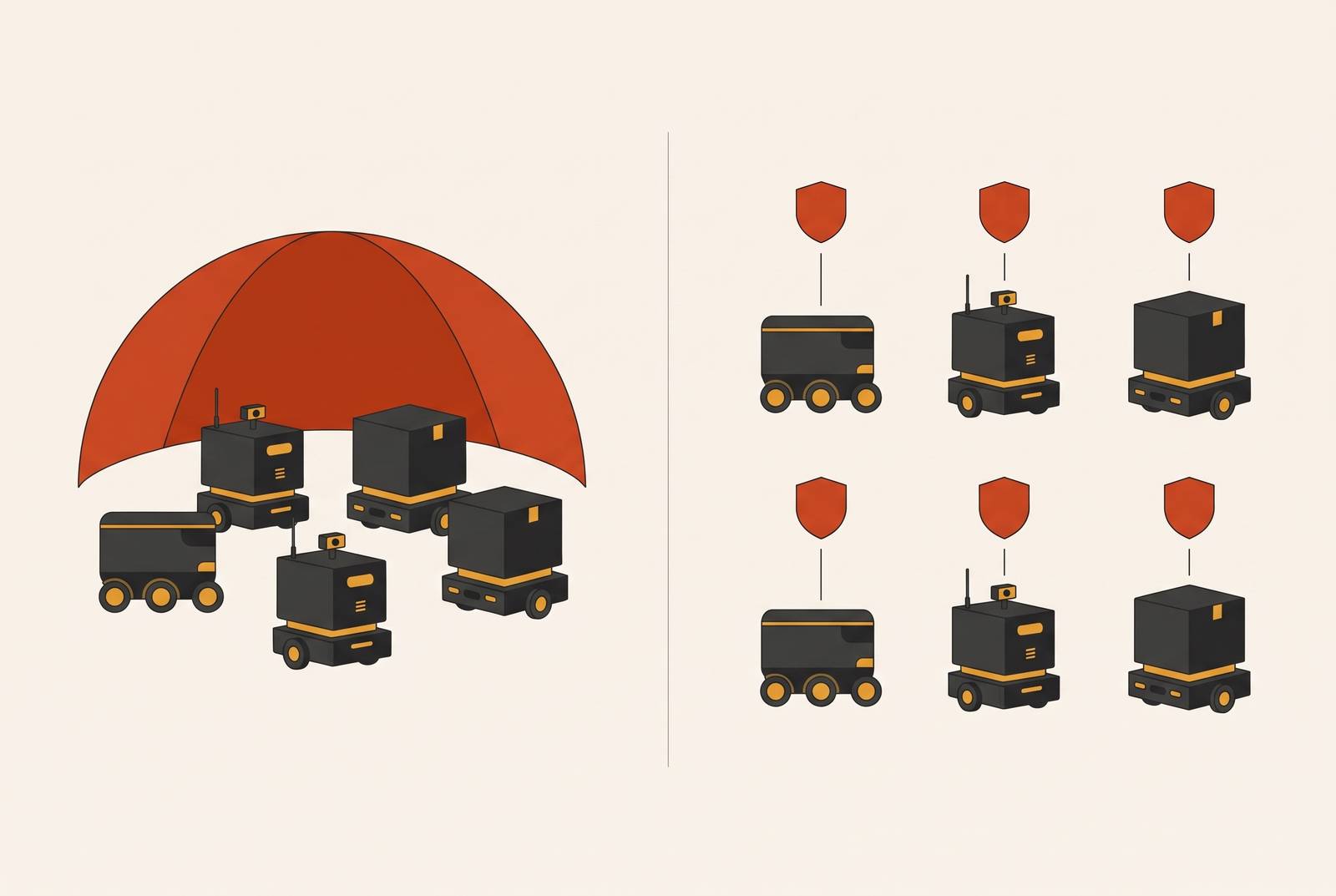
Inland marine coverage insures the physical assets in robot fleets at work, including autonomous robots traveling between job sites, within the policy’s terms and limits. A hybrid of blanket and scheduled coverage usually fits best, but its thresholds and limits must reflect unit costs, software-driven valuation changes, and multi-site deployment. The choice is technical because an unsuitable structure can leave losses underinsured despite a substantial total limit.
What inland marine was built for, and why robot fleets strain its original assumptions
A standard commercial property policy insures assets at a described premises. Once equipment leaves, coverage can thin or disappear. Inland marine was designed to close that mobility gap for property such as contractors’ tools, cameras, and medical equipment moving between offices. Those assets move, but their identities and values are generally stable enough to describe and insure without continually revisiting what each item does.
Autonomous robots share the need for mobile property coverage. Their operating characteristics are less stable, however. Software can change a unit’s capability and potentially its replacement cost without any physical alteration, while large fleets rotate interchangeable units across facilities and client sites. A robot’s risk profile can change between renewals even if it still has the same serial number. Inland marine addresses the movement of the asset, but its structure must also accommodate changes in what that asset is worth and how it operates.
How the scheduled-versus-blanket decision actually works, and what each structure trades away
Scheduled coverage lists individual assets with their descriptions and values. Its advantage is precision at the unit level. That precision supports certainty about what is insured, but only while the listed description and value reflect the asset at claim time. Maintaining the schedule is therefore part of maintaining the usefulness of the coverage.
Blanket coverage places a group of items under one shared limit, allowing additions and substitutions without constant policy updates. It reduces administration where equipment turns over frequently. However, a shared limit does not necessarily make the full amount available for any single item, because a per-item cap can restrict recovery.
In practice, most small-business inland marine policies combine the two structures. Ordinary items fall under a blanket limit, and each item above a scheduling threshold is listed on its own. This hybrid is the practical starting point. The threshold determines which assets need separate treatment, while the per-item cap determines how much the blanket portion can pay for one asset. Those provisions must work together to cover high-value equipment.
The per-item cap problem, scaled to autonomous mobile robot unit values
A single autonomous mobile robot can cost as much as many entire traditional equipment inventories. That changes the consequence of a modest per-item sublimit. A restriction that creates a manageable shortfall for conventional tools can leave only a small fraction of a robot’s value insured.
The relevant comparison is between the unit’s value and the amount available for that unit. Risklytics, a commercial insurance brokerage specializing in robotics and autonomous systems, places this kind of fleet coverage where standard equipment floaters would apply conventional caps. Giggins Insurance advises asking specifically about the per-item cap and whether it appears in the form or endorsement. This requires an explicit answer before binding. An operator relying on the shared limit alone may discover the restriction only when a loss is adjusted.
Traditional inland marine guidance resolves this by scheduling expensive outliers and blanketing the rest. That works when the outliers remain identifiable and stable. Robot fleets complicate both assumptions, because the units needing special treatment at binding may not be the same units, or have the same values, later in the term.
Why rapid valuation shifts make a static scheduled form unreliable for robot fleets
Giggins describes scheduled coverage as suited to “stable inventories” and “high-value, identifiable assets.” Robots are easier to identify than to keep stable in value and use. The same hardware can gain different operational capabilities after a software or firmware update, with a potential change in replacement cost. An unchanged schedule shows what the asset was worth before the update.
Deployment adds another source of variation. Two units of the same model may operate with different software versions, operational limits, and patterns of interaction with workers at different facilities. Consequently, a schedule can remain accurate about the physical machine while becoming incomplete about its operating context.
The valuation basis adds a separate decision. For rapidly evolving hardware, the difference can be significant. A listed value should not be treated as a substitute for understanding that settlement basis, which needs to be selected at binding.
Updating the schedule at annual renewal does not resolve every mismatch. An over-the-air update can change a unit’s risk profile or market replacement cost midterm. The timing is the structural weakness. Re-scheduling an entire fleet at renewal also restores much of the administrative work that blanket coverage was intended to remove, without addressing changes that occur before then.
How to insure a mobile robot fleet across multiple locations as scale and interchangeability change
A small fleet of a few expensive, individually distinct robots resembles a scheduled coverage case, because values are knowable and listing each unit is manageable. A large fleet of similar-cost robots favors blanket coverage as inventory turns over and administration becomes burdensome. But scale does not neutralize a per-item cap. A large shared limit can still leave every high-cost robot inadequately insured.
Unit interchangeability shifts the decision toward operational flexibility. Traditional schedules depend on matching an asset’s identity, description, and ownership to the item lost. That becomes harder when any identical robot can replace another in a deployment and the records do not clearly establish which unit was there. Interchangeability makes the promised simplicity of a scheduled claim depend on reliable unit-level records.
Fleets can occupy permanent facilities and client sites while other units are in transit. A scheduled description ties value to an asset rather than inherently to one location, but the recorded value may not reflect replacement cost in another operating context. Blanket coverage suits movement within its terms, but its shared limit must be enough for the most the fleet could be worth, including units in transit.
A hybrid will usually fit the fleet better. Its scheduling threshold and limits must be based on what units are worth, how often they are replaced, and where and how they work.
What good inland marine design for a robot fleet actually looks like in execution
The key questions need to be settled before binding. The first is what the per-item cap allows, and where the form or endorsement states it. The second is where the scheduling threshold sits and which robots exceed it. Both must be checked against what each robot actually costs. A threshold built around ordinary tools is not a sound default for expensive autonomous equipment.
Third, check whether the structure remains accurate as units rotate, receive updates, and move between sites. A blanket arrangement must make clear which units are worth more than its per-item protection, and a schedule must describe how units are deployed as that changes. The structure needs to fit the fleet’s changes throughout the policy term.
Fourth, identify which loss scenarios shaped the limits. Giggins advises modeling theft, fire, and rollover scenarios. Robot fleets also face events that can affect many units at once, including cyberattacks and coordinated facility incidents. Limit sizing must distinguish a single-unit loss from a multi-unit event, while recognizing that sufficient limits do not establish coverage for an excluded cause.
Fifth, the settlement basis needs to be set at replacement cost or actual cash value. That choice belongs in program design. For fast-changing hardware, depreciation can widen the distance between a settlement and the cost of restoring the fleet. The resulting decisions need support from proof of ownership and accurate asset values maintained before a loss.
Why inland marine is only one layer of what a robot fleet actually needs
Inland marine addresses the physical asset. Third-party injury, software failure, production downtime, and cyberattack require separate coverage analysis. General liability and products liability cover third-party bodily injury and property damage. Verisk released ISO endorsements CG 40 47 and CG 40 48, available from January 2026, that allow carriers to exclude claims tied to generative AI. Operators need to know whether these endorsements are present and applicable before assuming that liability coverage responds to an AI-navigation failure.
Technology errors and omissions coverage covers wrongful acts or performance failures tied to technology that general liability and cyber policies often do not cover. A control-platform error can cascade into equipment damage, defective output, or facility-wide shutdowns. Cyber coverage presents another boundary problem. Property damage from a cyberattack may be excluded by a property policy’s cyber exclusion and by a cyber policy’s property damage exclusion.
Axis Insurance built a program for companies that make and deploy autonomous robots. Its coverage includes bodily injury and property damage from AI navigation or perception failures, physical damage from cyberattacks taking over robot controls, and production losses from software updates or sensor failures without physical damage. It also addresses cases where a third-party component defect produces a claim against the integrator. These provisions respond to failures that cross conventional coverage boundaries.
Tokio Marine & Nichido Fire Insurance announced plans to introduce AI robot insurance in November 2026 for wheeled, four-legged, and humanoid robots. The announced policy covers repair or replacement, third-party injury and property damage, and substitute-worker wages or stand-in robot rental fees while a machine is unavailable. Its scope extends beyond replacing damaged hardware. Together, these products illustrate a market response to the combined physical, operational, and liability exposures of autonomous systems.
Regulation reinforces the need to examine those exposures separately. The EU’s Product Liability Directive must be transposed by member states by December 9, 2026, and applies to products placed on the market or put into service after that date. It expressly treats software, including AI, as a product subject to strict liability, and this includes embedded systems, standalone software and SaaS. California’s AB 316, effective January 1, 2026, bars defendants that developed, modified, or used an AI system from avoiding liability by attributing harm to its autonomous conduct.
Public-road deployment brings additional liability requirements. The Connecticut Office of Legislative Research found that a large majority of states have laws addressing liability coverage for operating or testing autonomous vehicles. California requires manufacturers to show that they have substantial insurance, a surety bond, or proof of self-insurance before they test or operate on public roads. Alabama mandates a significant minimum for driverless automated commercial trucks, while Arkansas sets a lower minimum. These requirements make the precise deployment description relevant beyond the inland marine form.
Why the underwriting submission determines whether any of this coverage actually holds
The underwriting submission tells the carrier how the fleet works so it can decide what to charge and cover. Describing autonomous robots merely as “tools and equipment” or “mobile machinery” invites treatment under conventional equipment assumptions. Those assumptions shape per-item caps and valuation defaults. Unless the submission explains software versioning, multi-site deployment, and fleet-wide events, the underwriter has little basis for departing from them.
The submission must clearly and accurately state the intended scheduling threshold, per-item protection, blanket limit sizing, and valuation basis. Specialist placement depends on making the exposure legible. The records supporting that description also need to remain useful at claim time, when ownership and asset values must be established. For a fleet that grows, rotates units, and receives over-the-air updates, documentation is an ongoing operating discipline.
Broker commission is already included in the premium whether a specialist places the coverage or not. Using a generalist and accepting conventional form defaults does not in itself save on commission. The decisive submission is one that gives the carrier enough detail to structure coverage around the deployed fleet, with its limits, valuation terms, and exclusions understood before a claim tests them.