Autonomy-Specific MSA Clauses That Restructure Your Entire Coverage Stack Before Your Robot Ships
Robotics startups should check whether MSA promises outrun AI-excluded policies.

MSA insurance clause review for hardware and robotics startups must connect the liability a company accepts to the losses its policies actually cover. Whether that connection holds depends on the autonomous-action indemnities, the operational scope, the additional insured requirements, and the exclusions. The coverage stack is restructured when the Master Service Agreement is signed.
Why MSA signing is the moment your coverage stack gets restructured
The robot is built, funded, and ready to ship. The obstacle is the contract the company just signed to sell it. An enterprise or government customer’s Master Service Agreement sets out the insurance the company must have before deployment, including the required coverage lines, minimum limits, and conditions for protecting the customer. It also assigns responsibility for losses that may involve more than one participant in the system. Those promises can exceed what the company’s existing policies were written to cover.
The mismatch begins with the assumptions behind those policies. Standard commercial forms assume there are human operators and deterministic failure modes, but autonomous systems make decisions that are not fully spelled out in advance. When a machine causes harm, the hardware maker, AI model supplier, and operator can all be implicated. The loss can involve more than one policy before it is clear who is responsible. Existing coverage silos were not written to resolve that allocation.
WTW’s Andrew Hill notes that many policy wordings still assume human involvement and predate the emergence of AI and autonomous robotics, so coverage should not be taken for granted. That warning has a direct contractual consequence. A company can take responsibility for autonomous behavior even when its insurance does not cover that behavior. The MSA establishes the obligation, but it does not amend the policy. For a startup reviewing its first enterprise agreement, the relevant question is therefore not simply whether every required policy exists, but whether its wording responds to the liability being accepted.
How autonomous action indemnification and scope clauses restructure liability allocation
An autonomous-action indemnity allocates responsibility for decisions that neither party fully anticipated at signing. That makes operational scope central to the clause. Standard indemnification language alone cannot settle who bears a loss when the limits of a system’s authority are unclear. An incorrect API call, a navigation decision that injures a worker, or a sensor interpretation that damages property can implicate the infrastructure provider, the deploying organization, or both.
Take a warehouse robot that damages a customer’s inventory. If the action was within its documented operational envelope, the MSA’s allocation for in-scope behavior helps determine who bears the loss. If the customer had expanded the robot’s authority beyond that envelope, the agreement needs a separate allocation for out-of-scope actions. The scope definition determines how the contract assigns the resulting loss, and a gap in that definition can leave exposure uninsured.
A well-drafted MSA therefore defines the operational envelope explicitly and separates liability for in-scope and out-of-scope autonomous actions. Amendment procedures support that distinction by requiring both parties to affirmatively approve changes. They help maintain coverage as well as manage the project. When a system gradually receives access or authority beyond its original specification without a formal amendment, the resulting liability may be unallocated by the contract and outside the risk contemplated by the existing insurance stack.
A data-processing addendum or statement of work can contain promises about accuracy, uptime, security, and the customer’s permitted use of system outputs. Those promises create obligations of their own. If they exceed the documented scope or the coverage purchased, a carefully drafted indemnity will not close the gap. These documents set the terms of the risk before an underwriter ever sees it.
The coverage lines an autonomy MSA typically mandates — and where each one breaks
General liability addresses the bodily injury and property damage an autonomous machine can cause around people and infrastructure. Site owners usually require proof of this coverage before deployment and must be given additional insured status. The fracture point is the treatment of AI-driven harm. Product liability coverage may respond, but whether AI software is a “product” remains unresolved across most U.S. states. A requirement for general liability does not settle how the policy will treat an autonomous decision that causes physical damage.
Technology errors and omissions enters the stack because the autonomy software is part of the product. Yet standard Tech E&O wording was written for software that a human operates. Here, the software itself makes the decision. A policy may therefore fail to respond to the very conduct that creates the company’s contractual exposure, even though the insurance schedule names the correct coverage line.
Inland marine or equipment coverage follows hardware beyond the company’s premises, including transit, customer sites, pilots, and demonstrations. Standard commercial property coverage applies only at the insured’s premises. But the equipment forms used for inland marine do not cover AI-based failure modes such as neural network misclassification, adversarial inputs, or software-update-induced outages.
With cyber coverage, an attack that takes over a robot’s controls can cause physical harm as well as data loss. The policy must cover physical harm as well as breach notification costs, while the MSA’s data-processing addendum may require security measures that go beyond what standard cyber coverage covers. A breach of those promises can create contractual liability the policy was not written to absorb.
Umbrella coverage comes in when the customer requires limits above what the primary policies can provide. More capacity does not repair excluded coverage. An umbrella that follows the underlying form does not fill an AI exclusion in the underlying general liability or E&O policy.
D&O addresses a different route from system performance to a claim. Public representations by executives about accuracy or safety can create securities and fiduciary exposure when the system fails to meet them. An attached absolute AI exclusion can remove coverage for defense costs of a claim rooted in that performance.
The AI exclusion wave that is quietly voiding the policies your MSA requires you to carry
The standard commercial market is filing exclusions that expressly remove AI exposures from policies enterprise MSAs require. That changes the review from interpreting silence to identifying an explicit carve-out. A policy title that once suggested possible coverage may now sit above wording that excludes the relevant cause of loss.
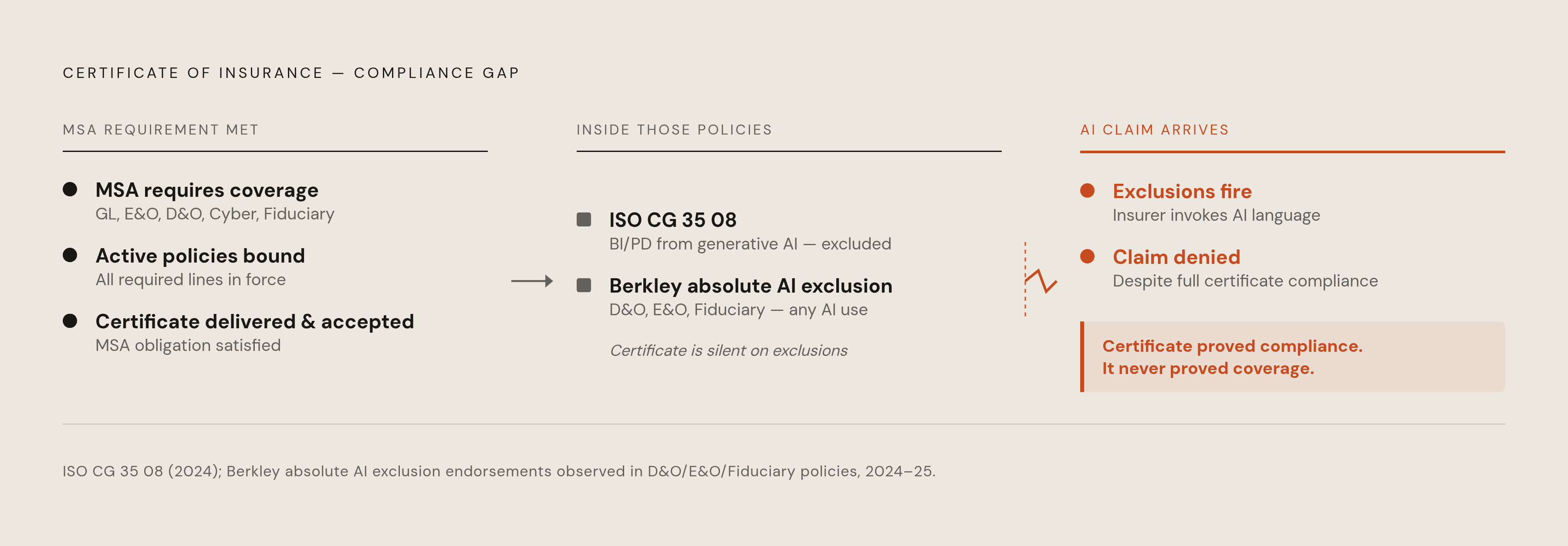
ISO issued three generative AI exclusions for commercial general liability in January 2026, namely CG 40 47, CG 40 48, and CG 35 08. CG 35 08 specifically excludes bodily injury and property damage arising out of generative artificial intelligence under the Products/Completed Operations Coverage Part. The distinction is important for physical hardware companies. An exclusion can apply to a physical injury involving a machine. The exclusion’s scope, including its focus on generative AI, must be read against the system involved.
Berkley Insurance filed an absolute AI exclusion for D&O, E&O, and fiduciary lines covering any actual or alleged use, deployment, or development of artificial intelligence. The retreat therefore extends beyond general liability. Relm Insurance, by contrast, launched PONTAAI, along with NOVAAI and RESCAAI, with coverage including bodily injury and property damage among other liabilities. Specialty coverage is emerging, but access requires more than a generic application routed through a standard placement process.
The practical distinction is between evidence of insurance and the substance of coverage. Active policies in every required line can satisfy an MSA’s certificate-of-insurance requirements even when exclusions remove the loss the agreement was intended to address. The certificate does not reverse those exclusions. A company holding evidence of compliance can still face a denied claim.
What three insurance clause traps should robotics startups watch for in an enterprise MSA?
The first trap is treating a certificate as an additional insured endorsement. The standard ACORD 25 certificate states on its face that it is issued for information only and confers no rights on the certificate holder. The endorsement is the operative policy document. If the MSA requires the customer to be named as an additional insured, delivering a certificate does not itself create that status. The customer can accept the certificate while the policy still lacks the required endorsement, leaving the discrepancy undiscovered until a claim arrives.
The second trap is leaving coverage territory unconfirmed. A policy’s territory clause defines its geographic reach, which may not match the customer sites contemplated by the agreement. A robot shipped to a Canadian distribution center or used in a European manufacturing pilot can fall outside a domestic policy’s territory. The destination must be within the area the policy covers. Otherwise, the insurance schedule calls for coverage at a deployment site that the policy excludes.
The third trap is an EU AI Act compliance warranty outside the insurance schedule. A system deployed without the required conformity assessment can breach that warranty and create contractual liability outside a standard insurance stack. Its placement makes the gap easy to miss. An insurance-schedule review can find every required line while overlooking a compliance promise elsewhere in the MSA that creates uninsured exposure. None of these traps requires a hostile customer. They are structural features of standard contract forms that persist unless someone specifically corrects them.
Why submission quality determines whether the specialty coverage your MSA requires actually binds
Identifying a specialty carrier does not complete the coverage work. The submission must describe how the autonomous system operates and how its risks are controlled. Standard commercial applications have no fields for supervision models, operating envelopes, geofencing, emergency stops, safety cases, or human override capability. That omission shapes the underwriting result. A generic submission can route autonomous-system risk into generic pricing, exclusions, or a decline because it does not explain the risk being transferred.
An underwriter left with a conventional equipment description may price a robot like rented construction equipment. The quote reflects the information provided. So the submission needs to use the engineering documentation the company already has to show how the system fits the promised coverage. Product quality alone cannot do that work. An underwriter cannot assess controls that the application does not describe.
Carriers writing affirmative AI coverage have converged on a specific documentary package. It includes a model inventory mapped to risk tier and a vendor diligence file for each foundation model provider in the stack. Monitoring telemetry and an incident response runbook need named escalation paths. Documented human override capability and a human-in-the-loop inventory for consequential decisions complete the account of how the system is governed. Companies that can provide this material can get affirmative coverage, while those that cannot may face exclusions no matter how good their product is.
The same principle applies to inland marine submissions. Telematics adoption, documented geofencing, and maintenance protocols give the underwriter evidence of risk management and control measures. These are underwriting positives that can support better pricing and terms. They also distinguish the deployed machine from a generic equipment description. The submission becomes the bridge between how the robot actually operates and how the policy treats it.
A specialist broker who understands autonomous-system operations can assemble it from the company’s existing technical documentation, and broker commissions are already priced into the premium whether or not a specialist places the policy. The MSA’s obligations, the system’s documented scope, and the underwriting submission must be connected before the coverage requirement can be treated as resolved.