Where Additional Insured Endorsement Wording Breaks Down When the Insured Product Causes Physical Harm
Standard endorsements often miss harm caused after delivery.
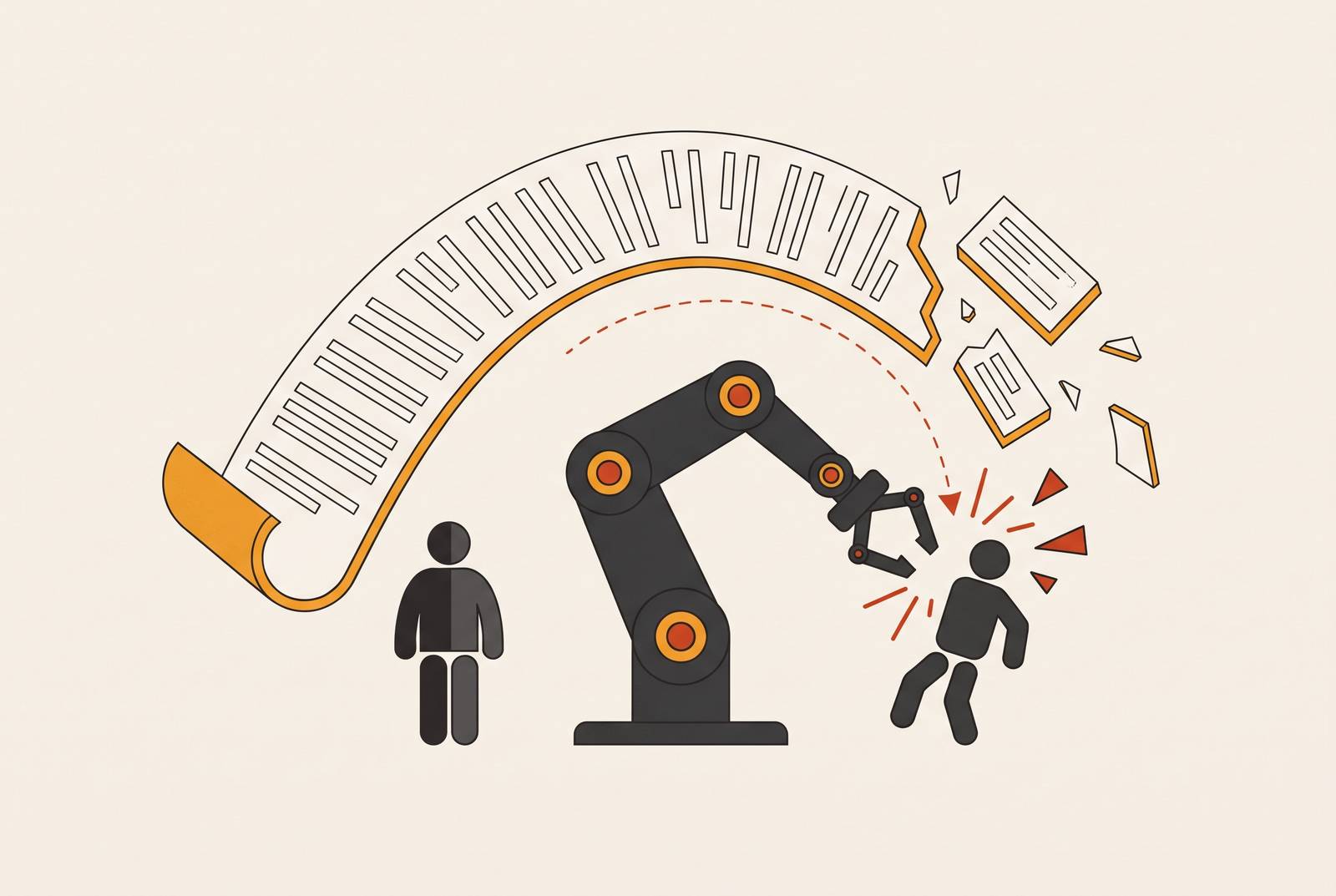
For hardware and robotics startups, a review of the insurance clause in a master services agreement must check both that an endorsement is in place and that its additional insured wording covers physical harm after delivery. Ongoing-operations coverage may end before an autonomous product causes injury, and exclusions can still apply to completed-operations and vendors coverage.
Why additional insured endorsements carry a built-in assumption that breaks for autonomous products
Liability must connect to the named insured’s identifiable acts, operations, or premises. CG 2026, the general-purpose additional insured form used outside construction, covers injury or damage caused, in whole or in part, by the named insured or those acting for it in ongoing operations or in connection with premises it owns or rents. The additional insured’s protection therefore depends on a defined relationship to the named insured’s conduct.
That causal link is narrower than a commercial promise to protect a customer. The shift from “arising out of” to “caused, in whole or in part, by” was intended to prevent coverage for the additional insured’s sole negligence. Scheduling imposes another boundary. A party not named in the schedule receives no protection under that scheduled form, preserving the insurer’s control over who is added.
Even a party properly named in the schedule gets only the coverage that the underlying commercial general liability policy provides. Its exclusions apply to the additional insured too. The endorsement allocates existing protection under the underlying commercial general liability policy. This architecture works when a human being is the proximate actor and the relevant conduct can be located within a bounded operation.
What changes when the product keeps making decisions after it ships
Autonomous hardware separates the harmful act from that bounded operation. Sensors, software, and AI models continue to select actions as conditions change after delivery. A chair can fall, but it cannot choose to move. By contrast, routing, braking, force application, and sensor interpretation can each produce a new decision that causes physical harm after the manufacturer’s work is complete.
When an autonomous logistics system executes a command that injures someone or damages property, the consequence belongs to general liability while the algorithmic failure belongs to technology errors and omissions. The loss is both at once. Separating the software error from the physical event does not separate the claim, yet the two policies approach it through different coverage triggers and exclusions.
Repair severity compounds that assignment problem. A minor autonomous-vehicle incident can require sensor recalibration, hardware replacement, and revalidation of the software stack. Historical loss data provides a weak basis for pricing a pattern that did not exist when the forms were drafted. Exclusions therefore offer insurers a way to bound uncertainty, but they leave the insured with a coverage question that additional insured status alone cannot answer.
The operational-anchor failure — why “ongoing operations” coverage ends exactly when autonomous risk begins
CG 2026 ties protection to the named insured’s ongoing operations. An enterprise customer may be an additional insured while a robotics company does work on its behalf, yet have no protection under that form if an autonomous failure happens later.
For a human-services business, the distinction has a natural endpoint. A contractor finishes the work and leaves, after which liability belongs to the products or completed-operations analysis. CG 2026 does not cover completed operations for an additional insured. Its use in service agreements, equipment or space arrangements, joint ventures, and event contracts reflects exposures anchored to identifiable operational activity.
Autonomous deployment exposes the mismatch at that endpoint. Once building and delivery are complete and the system operates independently, the customer’s principal exposure may only be starting. A customer named under CG 2026 alone has no completed-operations protection for that injury.
The completed-operations gap and why the form designed to fix it now has its own exclusion problem
CG 20 10 and CG 20 37 address different periods of exposure. The ongoing-operations form excludes bodily injury or property damage occurring after the relevant work is completed or put to its intended use, subject to its wording. CG 20 37 gives an additional insured coverage for completed operations. That distinction is essential where a defect causes harm only after delivery.
For an autonomous product, building and delivering the system can be complete while its decision-making continues. A post-deployment failure therefore falls into the very territory completed-operations protection was designed to reach. The remedy, however, depends on the base policy. Adding CG 20 37 cannot bring back coverage for a type of loss excluded elsewhere in the policy.
ISO’s January 2026 filings introduced CG 35 08 01 26, a generative-AI exclusion endorsement for Products-Completed Operations Liability Coverage. It targets bodily injury and property damage arising out of generative AI within the coverage territory that completed-operations protection is meant to address. Where the exclusion’s definition and causal wording reach a shipped product’s AI use, even incidental generative functionality may defeat the expected protection.
The distinction between autonomy and generative AI remains important when applying that language. The exclusion applies when the actual product and alleged cause of harm fall within its terms. This problem also extends beyond manufacturer-customer contracts into the distribution chain.
How the vendors endorsement fails distributors and downstream partners of autonomous-hardware companies
CG 20 15 protects vendors selling a manufacturer’s products, but its eight exclusions restrict what that protection includes. The policy document shows how this standard form is written in a policy. Coverage depends on the wording. A downstream business that integrates or services hardware performs activities very different from passing a product through unchanged.
Exclusion d deals with repackaging outside the original container. Exclusion c deals with physical or chemical changes that the vendor makes on purpose. For autonomous hardware, taking a unit out of its shipping configuration, reconfiguring sensors, or adding hardware raises questions about how those exclusions apply. Firmware work also calls for a close reading of the actual modification language, since coverage for all deployment work cannot be taken for granted.
Exclusions e and f introduce separate operational restrictions. They address failures to perform agreed inspections, adjustments, tests, or servicing, and demonstration, installation, servicing, or repair operations away from the vendor’s premises. Field deployment can therefore implicate several exclusions simultaneously. A distributor’s additional insured status does not establish that its integration work is insured.
Even a claim that survives those exclusions faces a contractual limit. Available protection is capped at the lesser of the amount required by contract or the available policy limits. If the manufacturer’s policy also excludes the relevant AI-related harm, the vendor has no upstream coverage to receive for that loss.
What the January 2026 ISO AI exclusion endorsements did to the entire additional insured framework at once
ISO’s three generative-AI exclusion endorsements, effective January 2026, apply to the policy on which additional insured coverage depends. CG 40 47 01 26 addresses both Coverage A, for bodily injury and property damage, and Coverage B, for personal and advertising injury. Its broad exclusion can remove protection for AI-related physical harm regardless of which additional insured form names the customer.
CG 40 48 01 26 targets Coverage B instead. It removes coverage for claims such as defamation and intellectual property disputes over AI-generated content, but does not itself place the same limit on Coverage A. CG 35 08 01 26 targets Products-Completed Operations Liability Coverage.
ISO’s stated rationale says the potential for events contributing to bodily injury, property damage, and liability from increased generative-AI use “is not contemplated under the ISO commercial general liability products.” ISO presents the endorsements as optional underwriting tools clarifying that intent. That framing has consequences for disputes. An insurer may argue that the wording confirms the intended boundary.
The presence of these optional endorsements must be established from the actual contract. The same care is needed with wording outside ISO, because there are hundreds of non-ISO additional insured endorsements, some of which cover little beyond vicarious liability. Manuscript and non-ISO exclusions may impose equivalent or narrower boundaries that a familiar form-number checklist will miss.
What tech E&O, cyber, and inland marine policies cover — and where each one leaves the additional insured framework with nothing to fall back on
Technology E&O ordinarily addresses economic loss from professional services failures, including software errors causing downtime or advice causing financial harm. Standard wording usually excludes bodily injury and property damage. The algorithmic error may be part of a service the policy covers. Yet the physical harm it causes may fall outside the policy, leaving the main loss uninsured under that line.
CGL approaches the same event from the opposite direction. Bodily injury and property damage fit its basic purpose, but an applicable AI exclusion can remove the loss because of its cause. The gap is structural. Technology E&O can reject the physical consequence while CGL rejects the AI-related cause, even though both arise from one autonomous action.
Cyber coverage is not a uniform substitute. Some insurers offer affirmative AI coverage, while others add exclusions for systems that act without real-time human approval. ISO’s 2023 cyber incident exclusion, CG 40 35 12 23, also removed the previous carve-back for bodily injury resulting from cyber events in GL policies using that wording. When a hacked industrial control system causes injury, coverage therefore needs to be checked on its own terms, since general liability coverage cannot be taken for granted.
Inland marine serves a different purpose altogether. It covers the named insured’s equipment in transit or at locations the insured does not own, including deployment equipment and components moving to field sites. It is first-party property coverage. D&O can likewise face AI exclusions when shareholders allege misrepresentation of AI capabilities or risk, so it does not supply a dependable alternative for related governance disputes. None of these lines provides an automatic backstop.
How should a robotics startup review additional insured and indemnification language in an MSA?
Relying on upstream insurance requires comparing the contract’s allocation of responsibility with the actual policy wording. For a first enterprise contract, that means reading additional insured and indemnification requirements against the same post-deployment loss scenario. The contract’s promise is not the coverage grant. A requirement to insure a customer does not establish that the insurer covers the autonomous failure underlying that promise.
Start with the relevant period of exposure. Confirm whether the policy includes ongoing-operations protection, completed-operations protection, or both, and whether the customer is properly scheduled where scheduling is required. Then examine the underlying AI exclusions, including the broad and products-completed operations forms. Coverage under CG 20 10 or CG 20 37 remains subject to exclusions such as CG 35 08 01 26.
For distributors and integrators, map routine deployment work against CG 20 15. Firmware updates, sensor changes, field installation, servicing, and packaging each require attention to the applicable provision. Verify primary-and-noncontributory wording and waiver-of-subrogation status as well. Their absence can complicate claims resolution between insurers even where coverage otherwise exists, while shared limits mean payments for an additional insured reduce the protection remaining for the named insured.
Underwriting submissions also need documented AI governance. Relevant details include the model type, proprietary or third-party API use, production data categories, output categories, and human-override workflows. Without those answers, workable coverage may give way to exclusions, sublimits, or refusal to quote. A specialist broker must read the complete policy before binding, because the decisive failure often lies in the interaction between endorsements.