How Custody-Chain Endorsements in Inland Marine Forms Protect Robot Fleets From Warehouse to Worksite
Custody-chain endorsements keep robots insured through every handoff.

Inland marine coverage for deployed robot fleets must follow the equipment through transit, third-party custody, storage, installation, and worksite use. A custody-chain endorsement spells out coverage for those handoffs and closes gaps left by property coverage tied to one location. Its effectiveness depends on the named equipment, valuation, custody terms, and records, while autonomous-system losses require coordination with liability, technology errors and omissions, and cyber coverage.
Why a robot leaving the warehouse is an uninsured moment under standard property coverage
A robot leaves a loading dock and passes into a freight carrier’s hands. With a standard commercial property policy insuring property at a described location, the robot leaves coverage behind when it leaves the warehouse.
A business owner’s policy covering a manufacturer’s named premises does not automatically protect its dies, tooling, or customer-owned material held by a supplier. Third-party possession is a separate exposure from ownership. For a robot fleet cycling through a manufacturer, integrator, warehouse, and worksite, that distinction is fundamental because much of its operating life takes place away from the insured address.
What insurance covers autonomous robots traveling between job sites?
Inland marine insurance is property coverage for equipment that moves from place to place. It descended from ocean marine insurance as commerce extended inland by rail and truck. The defining logic is that coverage follows the property rather than a fixed address, subject to the form’s terms and territory. A contractor’s equipment floater offers a useful comparison. Just as an excavator needs protection at each new job site, a robot needs protection at each new deployment.
That structure also accommodates high-value hardware through agreed-value or replacement-cost valuation. Inland marine coverage is typically written on an open-perils basis, covering physical losses except those specifically excluded, rather than restricting protection to a list of named perils. The coverage territory usually includes the continental United States and Canada, and some policies cover property worldwide. The actual territory still depends on the policy.
The category alone does not establish continuous protection. Inland marine comprises different forms for different exposures, including equipment, cargo, installation, and property held for others. A form that covers a robot in transit may not cover it while an integrator holds it for commissioning. The selected forms and endorsements must therefore match both where the robot goes and who controls it along the way.
How custody actually transfers across a robot’s journey and where each handoff creates an uninsured moment
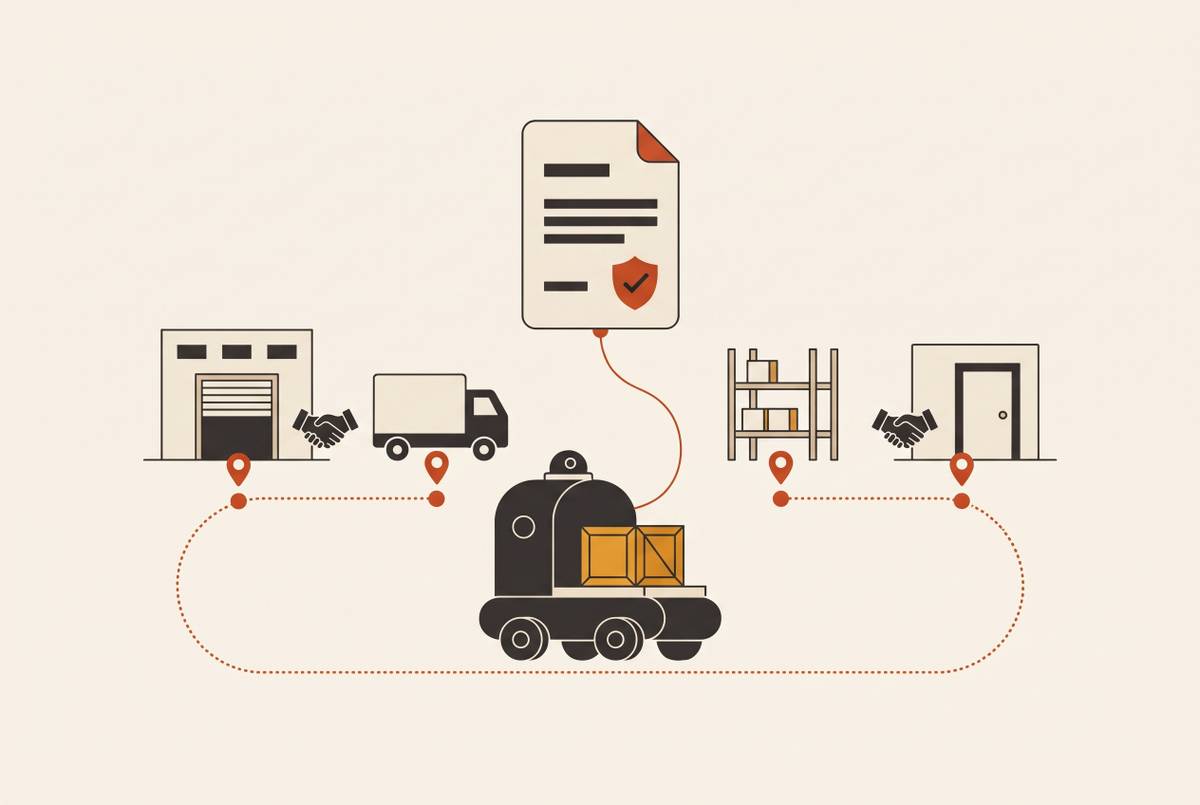
The custody sequence begins when the manufacturer releases the robot to the freight carrier. The carrier delivers it to the system integrator, which commissions it and ships it to the warehouse operator. The warehouse operator then deploys it to a worksite or hands it to the end customer. Each handoff changes who holds the asset. Without matching coverage, each transition can leave the robot outside the protection that applied at the previous stage.
Motor Truck Cargo coverage illustrates the boundary. It pays for loss or damage to freight for which the insured is legally liable while that freight is in its care, custody, or control. That protection ends when the freight leaves the covered custody, and it does not cover damage that occurred before custody began. Default carrier liability is not an adequate substitute. For LTL shipments, low per-pound liability limits can leave the payout far below the replacement cost of a high-value robot.
An integrator holding a manufacturer’s or customer’s robot acts as a bailee, a role that ordinary property and general liability policies typically do not address. Storage and deployment introduce further custodians whose coverage may not connect to the integrator’s protection. At a shared facility, a third-party logistics operator also faces contractual liability to the facility owner and workers, separate from the manufacturer’s product liability.
What the custody-chain endorsement does and how it closes each gap in the sequence
A custody-chain endorsement makes third-party possession an explicit part of the inland marine coverage. It extends protection to the specified property while another party holds it, rather than leaving coverage dependent on an assumed connection between separate policies. The wording governs which custody arrangements are covered. Before each handoff, written confirmation of coverage is essential, including whose policy will pay for a covered loss at that stage.
The direction of protection must also be clear. A Care, Custody, and Control endorsement allows an operator to add another party’s equipment to its inland marine policy while that equipment is in the operator’s possession. This addresses the custodian’s exposure, while wording extending an owner’s protection to property held by others addresses the owner’s exposure. Those are related but distinct coverage questions. Neither should be inferred merely because a policy bears the inland marine label.
The equipment schedule then defines what is insured and on what valuation basis. Scheduled coverage lists each high-value or custom robot with a detailed description and a set value, and agreed-value coverage avoids actual-cash-value depreciation when a claim is made. The endorsement should specify agreed value or replacement cost for current-generation autonomous hardware. Blanket coverage instead protects a class of equipment up to a single limit. Its adequacy depends on accurate total values and the applicable coinsurance terms.
Different stages also require different instruments. An installation floater covers equipment during installation at the customer’s location until project completion and the relevant ownership or operational transfer. Bailee coverage protects customer property while it is in the insured’s custody for service, storage, or transport, including its time in the warehouse. More complex fleets may warrant a monoline inland marine policy rather than a package-policy endorsement to avoid conflicting sub-limits and give underwriters a complete view. None of these forms retroactively covers damage predating the insured’s custody, so the endorsement is only as effective as the record establishing who held the robot and when.
Why autonomous systems make standard inland marine forms insufficient even when custody is covered
Continuous custody coverage answers where the robot was and who held it. Conventional equipment losses may involve theft, fire, collision, vandalism, or weather, but autonomous systems can produce physical harm through a software decision. The resulting claim crosses coverage boundaries. Damage to the robot, damage caused by the robot, and a failure in its control platform are not interchangeable exposures.
An autonomous logistics system executing a harmful command can implicate general liability for physical harm and technology errors and omissions coverage for the algorithmic decision behind it. A software update introducing the fault may also raise a cyber question. One event can engage all three lines. Repairs can be more involved than for conventional equipment because getting the robot running again may call for sensor recalibration, hardware replacement, and software-stack revalidation as well as physical repairs.
The Insurance Services Office’s CG 40 47 endorsement, effective January 2026, provides a commercial general liability exclusion for bodily injury and property damage arising out of generative artificial intelligence. The distinction between generative AI and autonomous decision-making generally prevents an overly broad reading of the exclusion, but still requires scrutiny where a robot’s loss involves generative AI.
Cyber coverage presents a separate boundary when an attack takes over robot controls and causes physical damage. Standard cyber protection focused on data breaches and network security may leave physical actuation outside its scope. Inland marine covers the asset and its custody, while tech E&O, general liability checked for AI exclusions, and cyber coverage designed for physical actuation cover the related causes of loss and the harm that follows.
What underwriters actually need to see before they will write a custody-chain endorsement on a robot fleet
Robot fleets lack the long actuarial history available for conventional equipment. Without that history, underwriters rely on scenario analysis, proxy data from cyber and tech E&O claims, and audits of engineering and governance. The submission becomes central to pricing and coverage terms. Thorough safety evidence and custody tracking reduce uncertainty about both the likelihood of loss and the party responsible when it occurs.
A useful custody submission identifies every holder, explains how transfers are recorded, and shows how damage would be attributed to a particular stage. The equipment schedule needs comparable precision. Serial numbers, model designations, and agreed replacement values support scheduled coverage in a way that a generic “robot fleet” description cannot. Blanket coverage also needs accurate total replacement values because coinsurance provisions can cut the payout when the declared value is too low.
Operational evidence must accompany the asset records. Continuous telemetry and automated intervention capabilities give underwriters evidence of how the system is monitored and controlled, while their absence can lead to refusal or substantial premium penalties. Loss runs document established operations. For newer fleets, incident logs and safety-validation records provide evidence where a formal loss history does not yet exist. ISO 10218 conformity evidence and software-governance records further demonstrate that safety has been treated as an engineering discipline.
The commodity description also affects the underwriting decision. A robot should not be submitted merely as general freight because underwriters price commodity classes separately and may exclude undisclosed commodities. Precision is therefore more than an administrative preference. It connects the equipment being shipped, the controls protecting it, and the coverage the insurer has agreed to provide.
How enterprise and government contracts create mandatory coverage requirements that the custody-chain endorsement must satisfy
Enterprise vendor reviews can turn a coverage gap into a deployment barrier. Customers often require certificates for tech E&O, cyber, and general liability at stated limits, while facility-access agreements for autonomous systems may also call for inland marine and bailee coverage. Contract compliance depends on the actual forms, endorsements, limits, and parties identified.
Contracts with shippers and customers may call for additional-insured or loss-payee status under the cargo or inland marine coverage. The policy wording must provide the status those contracts call for. At a shared facility, the logistics operator’s contractual exposure to the owner and workers remains distinct from the manufacturer’s product liability. A certificate by itself does not establish that these exposures are covered. Buyers also need confirmation that exclusions do not remove protection for the autonomous-system losses contemplated by the deployment.
Government contracts introduce another allocation of responsibility. FAR and DFARS use contractual liability and indemnification terms that may need a specialist’s review before they can be addressed in a standard commercial inland marine submission. This makes the contract an input to coverage design. The practical action is to read every facility-access, logistics-services, and integration agreement before binding, then build the form and endorsements around its insurance requirements.
What to do before the next robot ships — the coverage checklist a fleet operator should run
Before the next shipment, the operator should map every party that will hold the robot, from manufacturer through freight carrier, integrator, warehouse, and worksite operator. The map should show how custody transfers at each handoff. That map becomes the coverage specification. Existing property and inland marine policies should then be tested against each stage, with written confirmation of protection during transit and third-party possession rather than an assumption that one policy connects to the next.
The next step is to match equipment values to the appropriate coverage structure. High-value or custom robots need scheduled coverage that lists their serial numbers and agreed replacement values, while fungible lower-value units may fit blanket coverage if the total values are accurate. Every endorsement that sets the equipment’s value should use agreed value or replacement cost in place of actual cash value. Contract requirements should then be extracted before binding. Those requirements determine the needed endorsements and party designations, including additional-insured or loss-payee provisions where specified.
Before the first handoff, the operator should establish who records each custody transfer, what information is captured, and how the record would be produced for a claim. A specialist broker should also coordinate the inland marine form with tech E&O, general liability reviewed for AI exclusions, and cyber coverage designed for physical actuation. That preparation connects the custody map, engineering evidence, and contractual obligations to the policy language before the robot leaves the dock.