Inland Marine Insurance for Robots Shipped to Customer Sites
Standard property policies stop at your walls, but inland marine follows the robot.

A robot built to work in a customer's facility spends almost none of its working life in the building where its owner's insurance applies, a mismatch that produces a coverage gap catching robotics companies far more often than it should. A standard commercial property policy, including the businessowners policy many startups carry by default, is written to the four walls listed on the declarations page. It responds to a fire, a flood, or a theft at the addresses named in the policy, and nowhere else. So a six-figure robot shipped to a customer site is entirely uninsured under a standard business policy, no matter how carefully the company insured its own office or lab. That is not a loophole or a drafting oversight. Commercial property insurance has worked this way for as long as the line has existed, built around the assumption that the thing being insured stays where it was bought. Generic brokers rarely flag the problem because they are not pricing hardware that is designed, from day one, to leave the building and go to work somewhere else. For a robotics company, that design fact is the entire business. A robot that never leaves the warehouse generates no revenue, and the moment it does leave, it exits the only coverage most founders think to buy.
Inland marine insurance
The coverage line built for exactly this problem is called inland marine, and the name tells a new reader almost nothing useful. It has nothing to do with boats. The term is a holdover from marine cargo insurance, the old practice of insuring goods on ships, which over the following century got stretched to cover property that moves or sits away from a fixed location by any means. What matters for a robotics company is what the line does today: an inland marine policy, usually written as an equipment floater, insures each unit at its replacement cost no matter where that unit happens to be, whether in transit, running a pilot program, sitting at a customer site, or parked in temporary storage between deployments. The word "floater" describes the mechanism exactly. The coverage floats with the equipment instead of staying pinned to an address, and that portability is the whole reason the line exists. Once a company schedules a robot on an inland marine policy, that specific unit carries its own coverage wherever the job takes it, which is the only structure that matches how autonomous hardware actually gets used. What "replacement cost" means for a robot that cannot be bought off a shelf is where the real design work in a policy begins.
Scheduling robots on an inland marine policy and the complications in valuation
Scheduling is the part of the process where a policy either matches the business or quietly fails to. Each robot gets listed by serial number and assigned a value, and that value is supposed to represent what it would cost to replace the unit today, not what the company paid for it when it was ordered. For a custom robot, replacement cost is never a single number pulled from an invoice. It includes the hardware, the embedded software stack running on it, the calibration work needed to bring a replacement unit to the same operating state, and the lead time required to rebuild or re-source components that may no longer be available at the original price. If a policy schedules units at purchase price rather than current replacement cost, it will underpay when component costs rise or a supply-chain delay stretches the rebuild timeline, so the company comes up short exactly when it can least afford to be. Carriers also offer blanket inland marine coverage, a single limit spread across all scheduled equipment, and it works reasonably well for companies running large numbers of lower-value units. Robotics companies with a smaller number of high-value machines tend to need scheduled floaters instead, because a blanket limit can be wiped out by a single total loss of one expensive unit, leaving nothing for the rest of the fleet. Most underwriters miss the software and firmware valuation entirely: a robot treated as pure hardware on a schedule may get no value assigned to the proprietary perception model or control policy that actually makes it worth deploying. Fleet growth adds a final wrinkle. A unit built and deployed after the policy's effective date is not automatically covered until it is formally added to the schedule, so a company that deploys faster than it updates its policy paperwork is running uninsured hardware in the field without knowing it.
What inland marine covers in a robot incident
Inland marine answers one question only: was the robot itself physically lost or damaged? If a unit is crushed in transit, dropped from a loading dock, struck by a forklift, destroyed in a fire at a customer's facility, or stolen, the equipment floater is the policy that pays. It says nothing at all about what that same robot might do to someone or something else. If the robot injures a worker, knocks over a rack of inventory, damages a customer's product, or forces a production line to shut down, those are liability outcomes, and liability sits on a general liability or products liability policy, not on inland marine. When a robot failure halts a customer's line, the financial harm done to that customer is a consequential loss, not damage to the robot or physical damage to anything, and it is the kind of claim that may fall to a technology errors-and-omissions policy, or may not be insured anywhere in the program. A single bad afternoon at a customer site can produce three separate claims at once: an inland marine claim for the robot's own value, a general liability claim for the damage done to the customer's floor or equipment, and a tech E&O claim triggered by the software defect that caused the failure. A policy program assembled without that three-part exposure in mind can have a gap in all three places simultaneously, and the company often does not discover which gap until the claim gets denied.
AI exclusions added by major carriers in 2026 and their effect on inland marine and GL coverage for autonomous hardware
The liability side of that three-part exposure changed meaningfully in 2026. Berkshire Hathaway, Chubb, and Travelers each won state regulatory approval to largely remove AI liability protection from their standard commercial liability policies, and they added AI exclusion endorsements at renewal. Regulators approved more than 80% of those filing requests, and in several states the exclusions took effect as early as January. The detail that should concern any robotics company's risk management is how these exclusions arrived: they were added at renewal, in endorsement form, with no requirement that the policyholder affirmatively accept the new language. A company whose broker did not catch and flag the exclusion wording may not learn its coverage changed until a claim tied to an AI failure gets denied. The practical result for a robot operating in the field is a split that did not exist before: the inland marine policy still covers the damaged robot, but the general liability policy meant to cover what that robot damaged may now exclude the very claim that follows from an AI navigation or perception error. Berkley went further still, writing an absolute AI exclusion into its directors and officers, errors and omissions, and fiduciary liability policies, which removes board-level coverage for failures in how a company governed its AI deployment decisions, a detail that matters to any robotics company with investors who will ask hard questions about how those decisions were made and disclosed. Placing coverage with a carrier that has written an affirmative AI endorsement is the only way around a standard exclusion. CFC introduced affirmative AI wording in June 2026 across seven policies, including tech E&O, professional liability, and cyber. Beazley followed with its own affirmative endorsement to its cyber and tech E&O policies on September 17, 2026. Finding that language in writing, rather than assuming a standard policy still responds, is now a precondition for liability coverage actually paying out on an AI-related claim.
The coverage stack that follows a robot through its working life
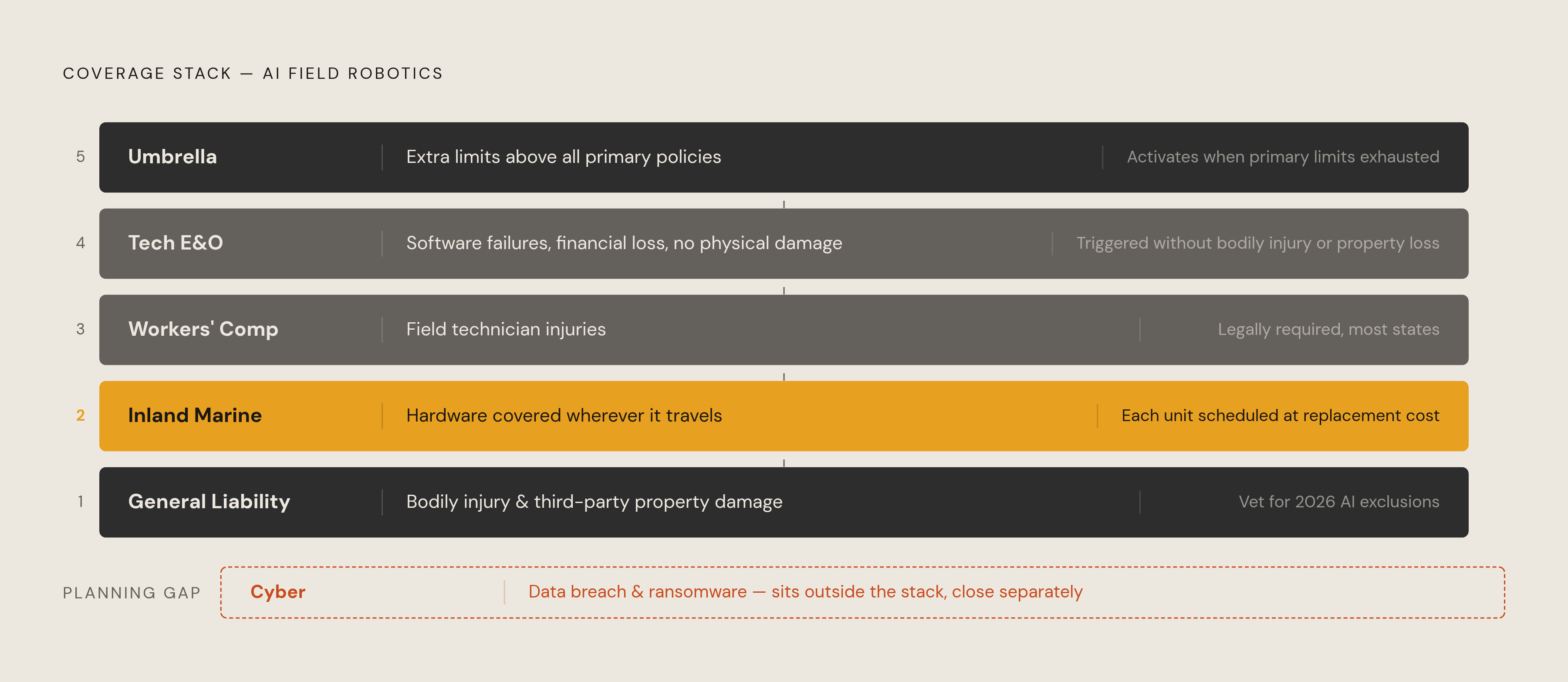
None of this works as a single policy. It works as five interlocking lines, each built to cover an exposure the others cannot touch, and inland marine is the second line in that stack. General liability comes first and forms the foundation, so it responds to bodily injury and third-party property damage; site owners will not let a robot through the door without proof of minimum per-occurrence limits, and that policy now needs explicit vetting for the AI exclusion language carriers added in 2026. Inland marine comes second: it covers the hardware itself once it leaves company premises, with each unit scheduled at replacement cost, and generic brokers most often undervalue or skip this line for robotics clients. Workers' compensation comes third, covering the technicians who install, service, and supervise machines out in the field, a legal requirement in most states and a real one given that field work generates more claims than office work. Technology E&O joins the stack as the fourth line once the autonomy software is the actual product, and it covers claims that arise from errors or failures in that technology; it is the first line of defense when a software failure costs a customer money without damaging anything physically, so enterprise procurement contracts typically demand substantial per-claim limits here. Umbrella coverage sits on top as the fifth line, and it adds extra limits above the primary policies whenever a specific contract calls for more capacity than the base program carries. Cyber risk deserves a planning note of its own, because a cyberattack that takes over a robot's controls and causes physical damage can fall into the gap between a property policy's cyber exclusion and a cyber policy's exclusion for physical damage, a gap a specialist broker has to close by name. Munich Re's aiSure takes a different approach built around a performance guarantee: the AI vendor warrants a level of performance, Mosaic Insurance underwrites and markets the warranty backed by Munich Re's reinsurance capacity and technical expertise, and payout triggers once the error rate crosses a set threshold. It is distributed through Mosaic Insurance with limited initial capacity, and it matters most to robotics companies that have contractually promised a customer a specific level of uptime or accuracy.
Contract requirements that force coverage before deployment
Most robotics companies do not build this stack because their own risk management asked for it. They build it because a site access agreement or an enterprise master service agreement demanded coverages and limits that a generic policy program never had. Most facilities will not let a machine through the gate without certificates already in hand, so the paperwork arrives ahead of the deployment. A company whose program is not already structured correctly cannot get the robot on site. Standard site-access language asks for general liability with the site owner named as an additional insured, proof of workers' compensation for any staff present on the floor, and evidence of equipment coverage for machines left on the premises, which makes the inland marine certificate something closer to a key that opens the gate than a document filed away for later. Enterprise contracts covering cyber exposure typically specify per-claim and aggregate limits well above what a startup carries by default, and they require the policy to cover first-party breach costs along with third-party liability, with larger enterprises or contracts touching sensitive data pushing those numbers higher still. The same contracts usually require tech E&O at meaningful per-claim and aggregate limits, and because many carriers bundle tech E&O with cyber coverage under one policy, tailoring the bundle to the actual deployment gives you a chance to structure both lines efficiently. Government contracts add their own layer on top: contractors are required to carry insurance for the perils their work exposes them to, and coverage becomes mandatory wherever commingled property, the type of operation, ownership arrangements, or other contract conditions call for it. The pattern plays out the same way across the industry. A robotics company signs a pilot agreement, receives the site's insurance requirements, and finds that its existing policy names no additional insureds, carries no equipment floater, and falls short of the required limits on every line. So the pilot sits on hold until the program gets rebuilt to match what the contract actually demands.
Why generic submissions produce policies that will not pay on a robot-related loss
A policy that actually pays out on a robot-related claim starts with an application that describes how the robot operates in the world, not a generic commercial property or liability form with a few boxes checked for "equipment." Standard applications have no fields for scheduled serial numbers, replacement cost tied to embedded software, site-access additional-insured requirements, or AI exclusion language on the liability side. A submission built for a conventional business produces a policy priced and written for a conventional business: padded with exclusions that have nothing to do with autonomous hardware, or built around a risk profile that does not match what the company actually deploys. Every gap described above, the valuation shortfall on scheduled units, the liability hole left by a 2026 AI exclusion, the missing tech E&O limit an enterprise contract demands, traces back to the same root cause: a submission that never told the underwriter what the robot actually does, where it actually works, and what it would actually cost to replace. The fix is a more accurate policy, built from a description of the robot's real working life rather than a template built for a business that stays inside its own four walls. Risklytics, a commercial insurance brokerage focused on robotics and autonomous hardware, drafts those applications and places floaters for deployed fleets where standard equipment forms fall short.