Transit, Deployment, and Operational Phases in Inland Marine Coverage for Mobile Robots
Robots need coverage tailored to transit, deployment, and operation phases.
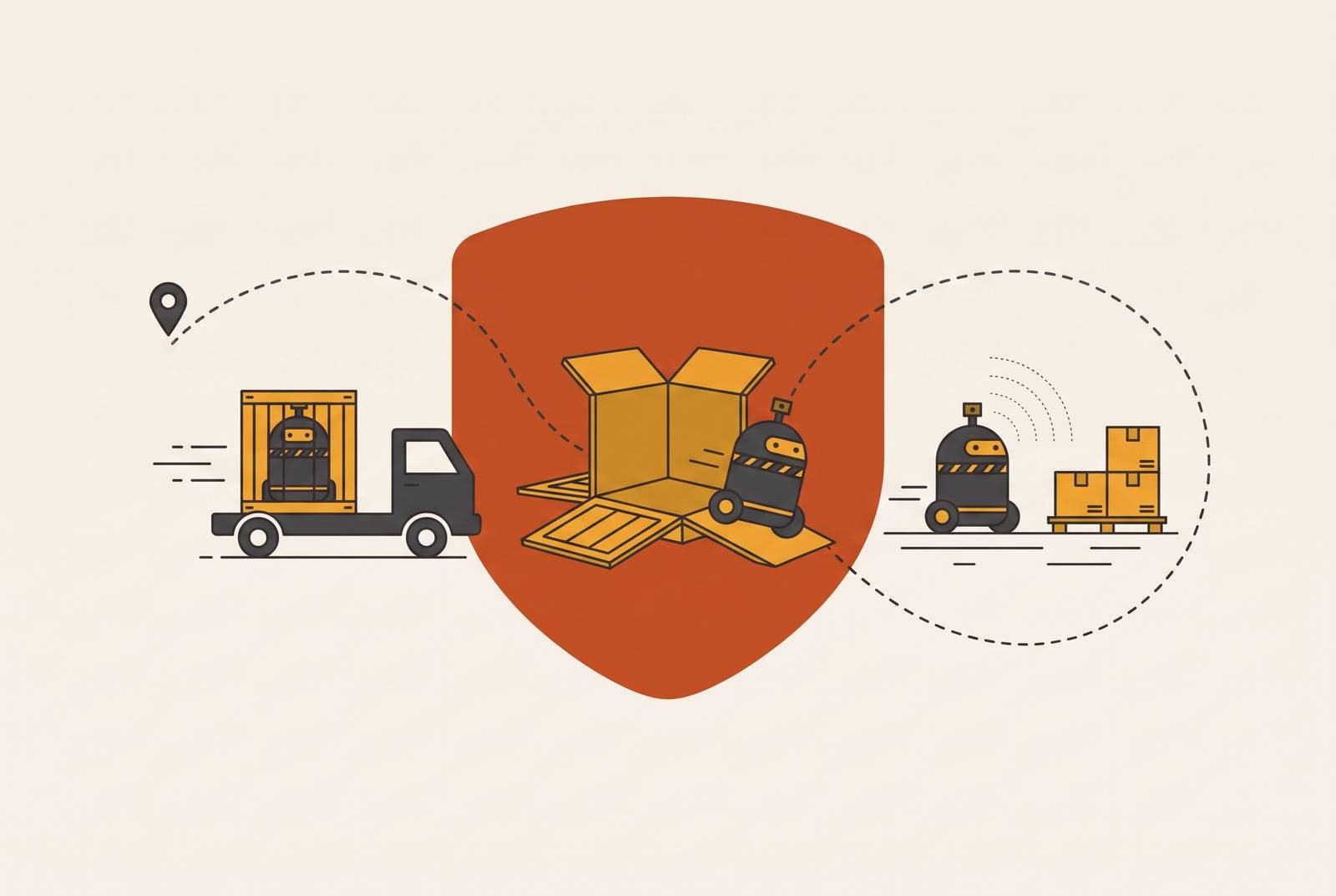
Inland marine coverage for deployed robot fleets should follow each asset through transit, commissioning, and autonomous operation across customer locations. An equipment floater can address physical loss, but it does not by itself cover third-party liability or downtime losses. A policy stack built around all three phases should have terms that account for the robot’s value, movements, and decision-making capabilities.
Why inland marine was built for property that moves — and why that matters for robots
Standard commercial property insurance centers on a described premises. Business personal property coverage under commercial property and businessowners policy forms therefore does not automatically travel with equipment on equivalent terms. Off-premises extensions are typically sublimited and exclude property in the custody of a common carrier. The coverage changes when the equipment moves, even if its job stays the same. For a mobile robot, that distinction appears as soon as the asset leaves the manufacturer’s facility.
Inland marine insurance was built to follow property in motion. The insured hardware remains the subject of coverage even as its location changes, subject to the form’s terms. That is the right structural starting point. A form designed to follow conventional equipment may not account for what a robot does when it arrives.
How a mobile robot’s working life maps onto three distinct coverage phases
A logistics autonomous mobile robot, a security patrol robot, and a construction inspection platform do different jobs but go through the same basic insurance phases. Each moves to a site, undergoes commissioning, and enters operation. The phases are distinct because the source of loss changes. An underwriter evaluating only the equipment’s description and value misses the transition from passive cargo to an active machine making decisions in a customer’s environment.
During transit, the robot is packaged and passive. Handling, vibration, and weather threaten the hardware while it is in someone else’s hands, so physical damage exposure is high and liability exposure is comparatively low. At deployment, the hardware is live while sensor calibration and software tuning for the site are still unfinished. This is the highest-risk window because the system can act before its behavior has been validated for the environment.
Once commissioned, the robot does its intended job autonomously, often near people. Physical damage, third-party liability, and business-continuity risks then coexist. Instead, commissioning introduces it before validation, while sustained operation makes it part of the robot’s ordinary working life. These distinctions explain why one generic equipment description cannot adequately express the risks of all three phases.
What insurance covers autonomous robots traveling between job sites?
An inland marine transit floater or equipment floater is the relevant starting point for a robot traveling on a carrier’s truck. Standard commercial property coverage may leave that trip out or cover it only through a limited off-premises extension. A policy can insure business equipment at the described premises without providing sufficient protection for the same equipment on its way to a customer.
Even where off-premises coverage applies, its sublimit may represent only a fraction of a mid-range mobile robot’s replacement cost. The asset can exceed that limit before performing any work. A floater addresses this mismatch by valuing the equipment in motion on its own terms rather than relying on the property policy’s extension. Its valuation still needs scrutiny, however, because a generic equipment form may undervalue embedded software and sensor arrays.
The relevant figure is the robot’s actual replacement cost. Treating the machine as conventional hardware can leave a shortfall even when its journey is covered. A transit form therefore needs to reflect the integrated asset. Coverage for the trip and adequate valuation are separate requirements, and satisfying one does not establish the other.
A return to the manufacturer for a software update or sensor replacement puts the asset back into the transport phase. That cycle may happen dozens of times, while installed equipment is usually associated with a one-time delivery. For a deployed fleet, transit coverage must therefore follow recurring movements rather than end its practical usefulness after the initial shipment.
The commissioning window — why deployment at a customer site is the coverage gap most companies miss
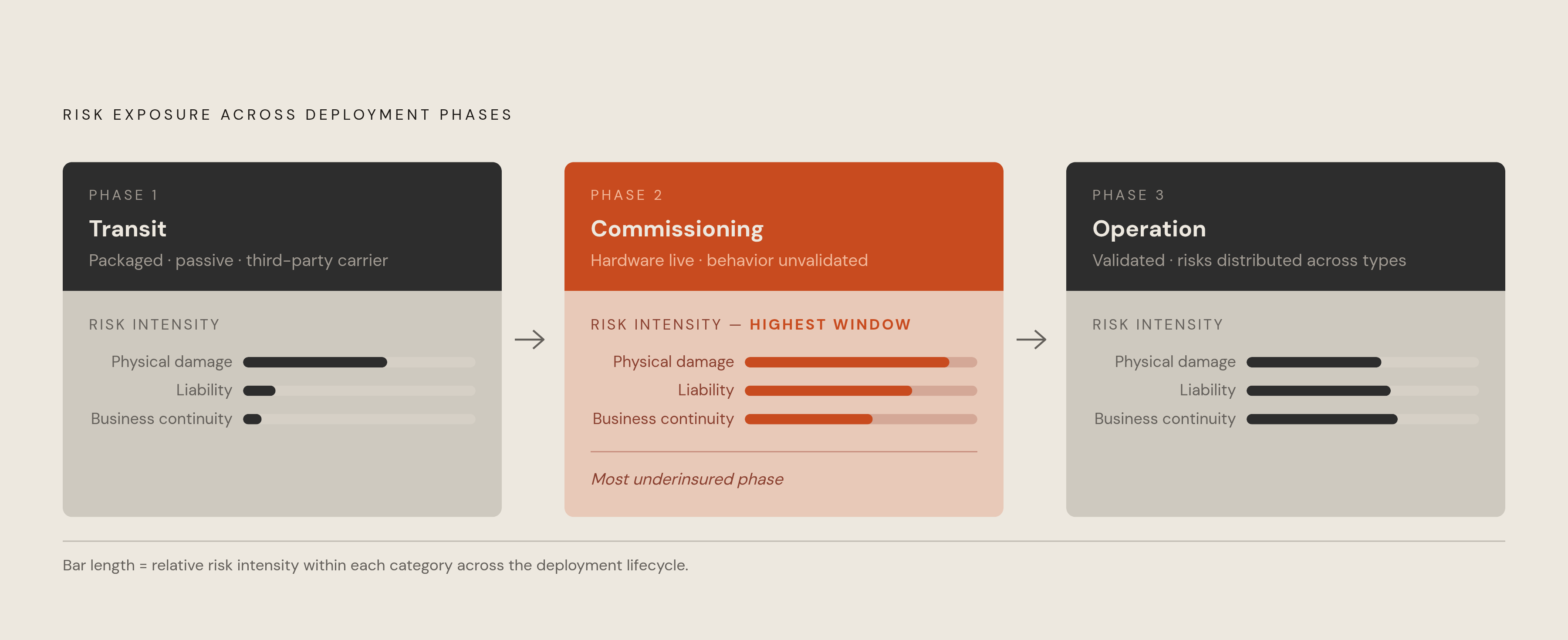
Arrival does not mean the robot is ready to operate. During commissioning, the hardware is live, but calibration, integration, and site validation are unfinished. This makes deployment both the highest-risk and the most underinsured window in the lifecycle described here. After transport, coverage needs to account for an active system whose behavior has not yet been validated at that location.
Sensor calibration failures can cause the robot to misread its surroundings before the deployment team has validated its behavior. Software version mismatches between firmware and the customer’s integration introduce a separate exposure. Meanwhile, the machine may be physically active before the customer has updated safety protocols to account for it. Physical installation is not the same as operational validation. A form that treats installation as the end of deployment can therefore draw its boundary at the wrong point.
Customer contracts make that distinction an immediate commercial concern. Insurance requirements often apply before a robot is allowed on site, triggering certificate-of-insurance demands precisely when the proposed coverage may still be generic or mismatched. A company may be unable to begin deployment if its insurance does not satisfy those requirements. Commissioning needs terms that address active autonomous behavior at a customer’s facility.
Operational phase risks — what happens when standard forms meet a robot that makes decisions
ISO CG 35 08 makes one potential liability gap explicit. The endorsement took effect January 1, 2026, and excludes bodily injury or property damage arising out of generative artificial intelligence, defined as a machine-based learning system, in the products/completed operations coverage part. The endorsement makes AI-related exclusions a concrete placement concern, with its relevance to an autonomous system dependent on the policy’s adoption of the endorsement and the applicability of its wording.
A navigation or perception failure can cause harm without a fixed mechanical defect being the central issue. Standard commercial general liability coverage therefore needs to be checked against both how the robot makes decisions and how it is built. The liability exposure follows what the machine does. A description that treats it only as mobile equipment leaves that defining feature inadequately addressed.
Robots working around people and outdoors face falls, drops, and collisions that do not resemble the damage profile of stationary equipment. Their integrated devices can make repairs costly and downtime protracted. An equipment floater may address insured physical loss, but that does not establish protection for the deploying company’s interrupted production or logistics function.
The distinction becomes sharper when no physical damage occurs. A sensor failure, a software update that breaks navigation, or a third-party component defect can take a robot offline and disrupt the function assigned to it. An equipment floater designed only to pay for physical repair does not cover the resulting downstream business loss. Operational protection consequently requires more than an adequate hardware limit. It must address the financial consequences of the robot becoming unavailable.
Responsibility can also extend beyond the fleet operator. One incident can generate claims against the hardware maker, software developer, and deploying company. Most vendor contracts cap liability at a fraction of annual fees and provide no performance warranties, leaving the operator exposed to risks those contracts exclude. Contractual recourse is therefore not a substitute for coverage. This multi-party chain is also where the experience of autonomous vessels offers a useful comparison.
What the marine sector’s autonomous vessel experience reveals about where terrestrial robot insurance is heading
Autonomous vessel insurance provides an analogy for terrestrial robots. The marine sector has worked through questions about decision-making liability, remote control, and multi-party causation while developing coverage products and regulatory frameworks. Its progress shows how insurance can develop around autonomous activity. It does not establish that a land-based robot has equivalent protection under an existing equipment form.
The International Group of P&I Clubs stated in July 2026 that liabilities from maritime autonomous surface ships were eligible for its pooling arrangements across all autonomy levels, including fully unmanned vessels. The IMO adopted the MASS Code in May 2026, with entry into force on July 1, 2026. This first global framework for autonomous vessel safety is non-mandatory until around 2032. Terrestrial mobile robots have no comparable statutory or regulatory framework outside the autonomous vehicle context.
The Shipowners’ Club developed a specialist liability policy for autonomous and remotely operated vessels after consultation with owners, operators, and manufacturers. Its all-risks coverage addresses collision, third-party property damage, cargo, contracts, injury to crew or other people, pollution, towage, and wreck removal. The approach begins with the activity and its participants. For terrestrial robotics, the useful comparison is that specialist coverage develops from the actual operating model rather than from the hardware’s superficial resemblance to conventional equipment.
Shore-based control raises the question of who is legally navigating, while overlapping system failures and human intervention complicate causation. Allocating liability among owner, remote operator, and technology provider has a direct structural parallel in robot operations. The comparison leaves the legal questions on land unanswered. Companies are deploying robots before comparable rules and policy forms have been developed, so the wording they negotiate now carries more weight.
What a policy built for all three phases actually needs to address
For transit, the insured value must reflect full replacement cost, including embedded software, sensor arrays, and specialized tooling. Coverage must follow return trips for maintenance and updates as well as the initial shipment. Recurring movement is part of the exposure.
For deployment, coverage must attach when the robot leaves the manufacturer’s facility and remain active through commissioning and validation. The form should not require the robot to have reached its final validated state before protection applies. Otherwise, the coverage condition can exclude the very window in which calibration and integration remain incomplete.
Operations require four components to work together. The equipment floater must cover how the robot works in autonomous operation as well as in fixed-use operation, while the liability form must clearly include AI navigation and perception failures without ISO CG 35 08 or equivalent AI exclusions. A cyber provision must address data breaches and physical-consequence events, such as a hijacked navigation system. Business-interruption or business-continuity coverage must cover downtime losses even when there has been no physical damage.
The underwriting submission is where these distinctions enter the placement process. It needs to describe the operating environment, autonomy level, sensor stack, and software update cadence so the proposed terms can be evaluated against actual behavior. Generic descriptions invite generic forms. A specialist broker’s review before binding is the practical means of identifying AI carve-outs, autonomous-operation limitations, and sublimits that do not match the asset’s value. At placement, the operator can still address those provisions before a loss.